U.S. finalizes SAFE III fuel‑efficiency rule — what it means for Canada’s 2035 ZEV goal and automakers
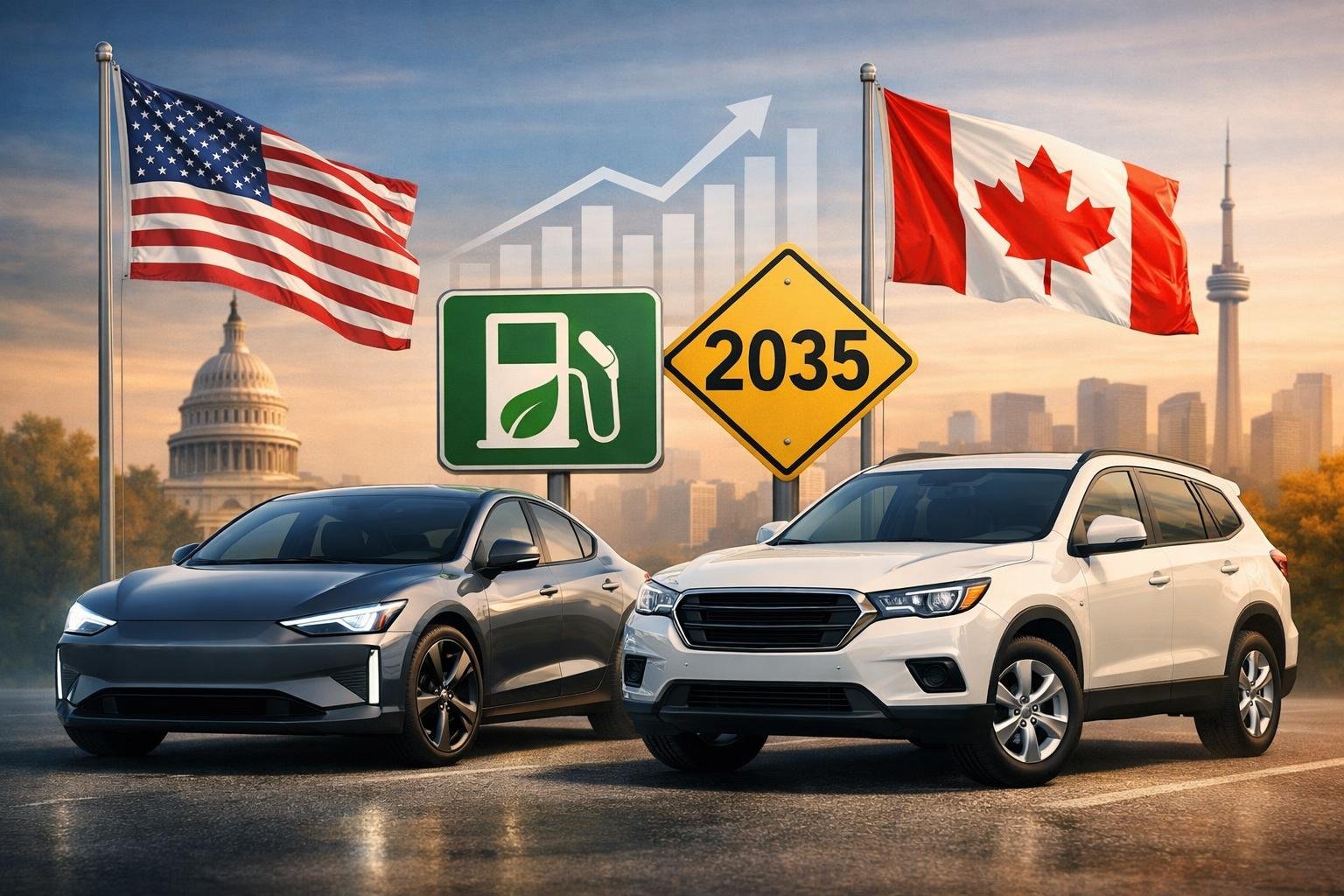
The U.S. Department of Transportation and NHTSA have finalized a new federal fuel‑efficiency rule — the Safer Affordable Fuel‑Efficient (SAFE) Vehicles Rule III, branded by DOT as “Freedom Means Affordable Cars.” The rule recalibrates U.S. light‑duty fleet targets for model years 2022–2031 and changes compliance mechanics. That federal shift matters to Canada because Ottawa has a formal 2035 zero‑emission vehicle (ZEV) sales target and has pledged to align with the most stringent North American standard after 2025.
For Canadian shoppers and industry observers, the confirmed facts tell a clear starting story: U.S. federal requirements have moved in a different direction from earlier federal planning, Canada remains committed to a 2035 ZEV mandate, and the North American vehicle market is highly integrated — so Ottawa will need to decide which U.S. standard, if any, it follows.
Key elements confirmed by U.S. government materials and the Federal Register include:
- The federal fuel‑economy targets for the light‑duty fleet were recalibrated for model years 2022–2031.
- NHTSA stated the final rule bases CAFE stringency on fuel‑economy performance of gasoline/diesel vehicles and excludes imputed electric vehicle (EV) or plug‑in hybrid (PHEV) electric operation from the baseline feasibility determination.
- The rule revises classification rules and modifies how credits and compliance pathways operate (including changes to trading/credit mechanics).
Canada has its own regulatory framework and a statutory policy goal that remains intact: the federal government requires 100% of new light‑duty car and passenger‑truck sales in Canada to be zero‑emission by 2035 (announced June 2021).
Since 2020, Canada’s stated posture on post‑2025 standards has been to align with the most stringent North American performance standard, whether that is the U.S. federal standard or stricter state programs such as California’s. That alignment policy means Ottawa must evaluate SAFE III alongside California/section‑177 state programs and its domestic ZEV target when deciding regulatory alignment.
Separately, the Canadian auto industry and supply chain are highly integrated with the U.S.: a large share of Canadian vehicle production is exported to the United States, and vehicles sold in Canada frequently come from U.S., Mexican or other North American production. That cross‑border integration is an important background factor in regulatory and commercial decision‑making.
- U.S. NHTSA estimate: SAFE III is estimated by the agency to yield a U.S. fleet average of about 34.9 mpg by model year 2031 (U.S. figure).
- Earlier federal planning under the prior administration projected a much higher U.S. fleet‑average figure often cited at about 50.4 mpg by 2031 (U.S. figure used for comparison).
- SAFE III excludes imputed EV/PHEV electric operation from the baseline feasibility calculation and changes vehicle classification and credit/credit‑trading mechanisms.
- Canada policy: Canada’s mandatory target remains that 100% of new light‑duty car and passenger‑truck sales be zero‑emission by 2035.
- Alignment posture: Canada has publicly committed to align after 2025 with the most stringent North American standard — that could be the U.S. federal standard or the stricter California/section‑177 regime.
What This Means for Canadian Buyers
At this stage the confirmed facts point to three practical takeaways for Canadian consumers:
- Canada’s 2035 ZEV sales target remains official federal policy, so Ottawa still has a domestic benchmark for new‑vehicle emissions.
- The U.S. federal standard has been formally relaxed relative to the prior federal trajectory, per NHTSA’s SAFE III recalibration and the agency’s estimated 2031 fleet figure (≈34.9 mpg). That divergence creates a policy choice for Canada because its alignment commitment ties it to the most stringent North American standard after 2025.
- Because the Canadian and U.S. vehicle markets and supply chains are highly integrated, any Canadian alignment decision — to follow SAFE III, follow California/section‑177 standards, or adopt a distinct path — will be materially important to how manufacturers manage compliance and vehicle allocations for the Canadian market. However, whether manufacturers will change Canadian pricing or model availability as a direct result of SAFE III is not confirmed and requires further verification.
Speedhounds Analysis
The confirmed record leaves Canada with a clear but consequential decision: stick with its domestic 2035 ZEV objective while aligning with the most stringent North American standard, or reinterpret alignment in light of SAFE III’s lower federal stringency. Canada’s declared approach — to align with the most stringent option — preserves the flexibility to choose California‑level standards if Ottawa judges they better support the 2035 ZEV commitment.
Because Canadian vehicle production and sales are so tied to the U.S., automakers will be watching Ottawa’s alignment choice closely. A decision to align with the stricter California regime would maintain strong regulatory pressure toward higher EV penetration in Canada; a decision to follow SAFE III would lower federal regulatory stringency in the North American context. Which path Canada selects will influence regulatory compliance planning, but concrete consequences for Canadian pricing and model availability are not established by the confirmed material and need separate verification.
What exactly did the U.S. rule change?
The Safer Affordable Fuel‑Efficient (SAFE) Vehicles Rule III recalibrates U.S. federal fuel‑economy (CAFE) targets for model years 2022–2031, revises vehicle classification rules, modifies credit and compliance pathways, and excludes imputed EV/PHEV electric operation from the baseline feasibility calculation. The final rule is published in the Federal Register (Vol. 91, No. 188).
What is the U.S. fleet‑average estimate under SAFE III?
NHTSA estimated SAFE III would yield a U.S. fleet average of roughly 34.9 mpg by model year 2031. That figure is an agency estimate for the U.S. fleet.
Does Canada still have a 2035 zero‑emission target?
Yes. The Government of Canada has a mandatory target that 100% of new light‑duty car and passenger‑truck sales be zero‑emission by 2035, announced in June 2021.
Will Canada automatically follow the new U.S. federal standard?
Not automatically. Since 2020, Canada has said it will align after 2025 with the most stringent North American standard. That means Canada could align with the U.S. federal standard or with stricter state programs such as California/section‑177 standards; whether Ottawa will change its post‑2025 alignment choice in response to SAFE III has not been confirmed and requires further verification.
Will SAFE III change Canadian vehicle prices or availability?
Any claim about changes to Canadian pricing or model availability would require Canadian‑specific evidence. The U.S. agency estimated lower new‑vehicle upfront costs for U.S. buyers under SAFE III, but no authoritative Canadian price‑impact analysis or definitive evidence about changes to Canadian model availability was identified in the confirmed material; these outcomes require verification with Canadian market data and OEM statements.