Budget 2026 Sets Aside $634 Million for EV Charging Across Canada
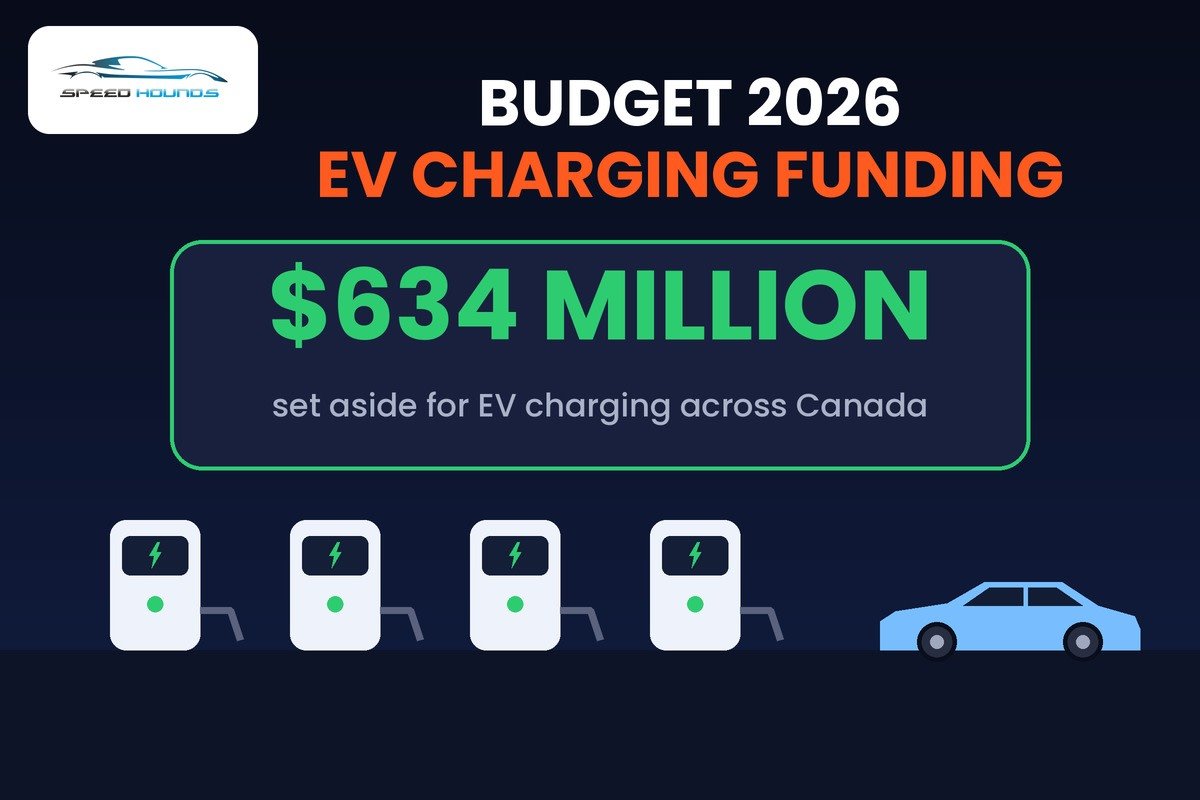
Budget 2026 sets aside more than $634 million for EV charging, according to Auto123, with most of it going to a renewal of Natural Resources Canada’s Zero-Emission Vehicle Infrastructure Program (ZEVIP). The plan targets more than 55,000 additional chargers in high-need locations, which Auto123 says would roughly double the federally backed network of more than 50,000 ports.
Where the money goes
| Item | Amount | Timeline |
|---|---|---|
| Renewal of ZEVIP | $587 million | Five years, starting fiscal 2027-28 |
| Charging research and development at Natural Resources Canada | $45 million | Five years |
| Electrification of the federal fleet | $2.2 million | Five years |
The budget builds on a $1.5-billion charging package and 8,000 ports announced earlier in 2026. The 55,000 target covers both Level 2 chargers and Level 3 DC fast chargers.
Who the chargers are meant for
The stated priorities are rural routes, multi-unit residential buildings and public workplaces. Those are the places where drivers most often lack a reliable way to charge: condo and apartment residents without a dedicated outlet, and travellers on highways outside major cities.
ZEVIP funds chargers in public places, on streets, in multi-unit buildings, at workplaces and for fleets. Under the current program, Natural Resources Canada covers up to 50% of eligible costs for owners and operators, to a maximum of $2 million per project, and up to 75% for Indigenous organizations and communities. Electrek reports the same cost-sharing under the renewal. The existing program was extended to March 31, 2027, which is why the renewal funding begins in fiscal 2027-28.
What could slow the rollout
Auto123 notes that delivery depends on site selection, grid connection timelines and matching provincial efforts, such as Hydro-Québec’s expansion of dynamic power-sharing. Federal money pays for chargers, but a site still needs a utility connection with enough capacity before it can open.
The charging industry has welcomed the multi-year commitment. Travis Allan, CEO of the Canadian Charging Infrastructure Council, said “The charging industry is really encouraged by the multi-year investment in the budget,” as reported by Electrek.
No new rebates for buyers
The budget adds no new purchase incentives and changes no eligibility rules. The federal Electric Vehicle Affordability Program continues to offer up to $5,000 for eligible battery-electric vehicles and $2,500 for plug-in hybrids, with the amounts stepping down annually through 2030.
What it means for Canadian drivers
The money flows to charger owners and operators rather than to drivers, so the effect shows up as new sites rather than a lower price at purchase. With the renewal starting in fiscal 2027-28, buyers weighing an EV today should not expect the new network to be in place immediately. The focus on condos, workplaces and rural corridors does point to the gaps that matter most to people without home charging.