What You Actually Pay for a New Car in Canada: MSRP, Freight and PDI
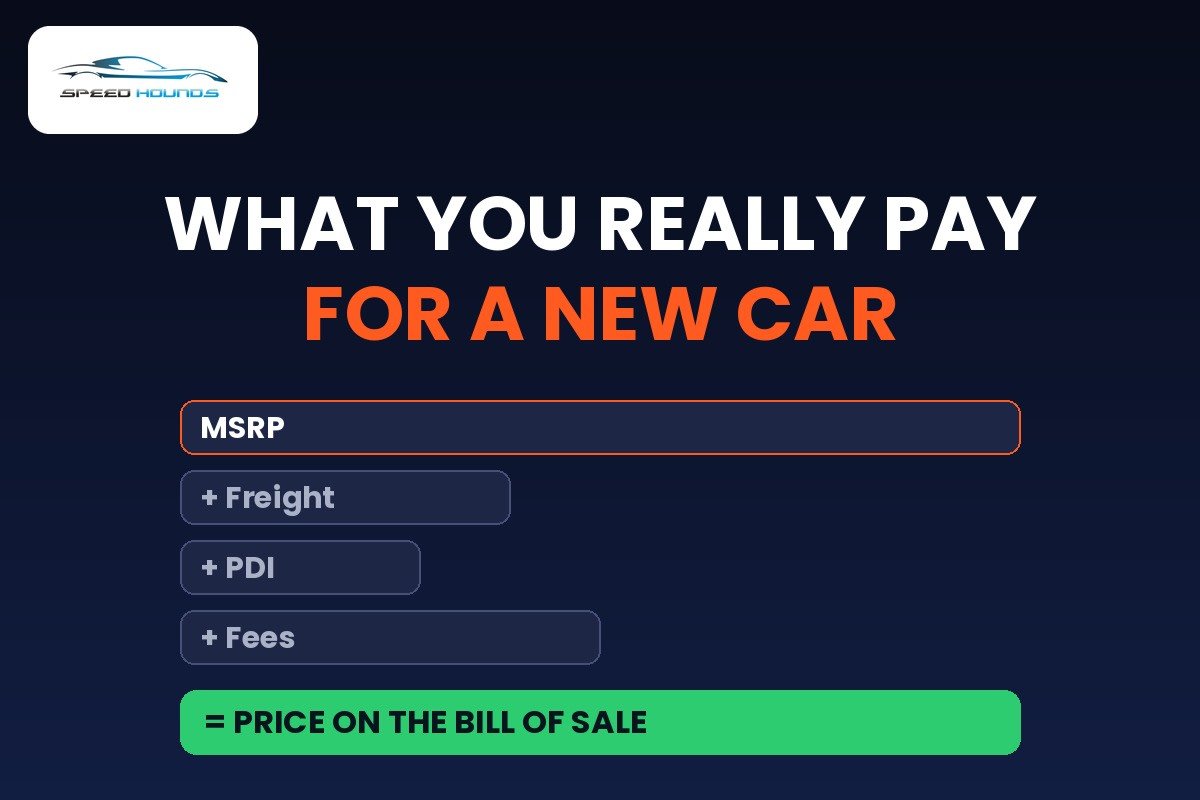
The price on an automaker’s website is rarely the price on the final bill. The manufacturer’s suggested retail price, or MSRP, is a starting point, and Ontario’s dealer regulator describes it as a guideline rather than a fixed price. Between that figure and what you pay sit freight, pre-delivery inspection, dealer fees, taxes and licensing, and the rules on which of those must appear in an advertised price depend on the province.
What MSRP actually tells you
MSRP is the price the automaker recommends. It appears on the manufacturer’s website and in its build-and-price tools, and it is the figure that usually leads a press release. Dealers set their own selling prices, and those vary with each dealer’s fees, discounts and promotions. The MSRP is a reference point for comparing trims, not the total you will pay.
Many Canadian price announcements list the MSRP before freight and preparation charges. A recent example is Subaru Canada’s 2027 BRZ lineup, where the MSRP and the price including freight differ by thousands of dollars, as the worked example below shows. Reading the fine print of a release or ad to see what a price includes is the first step in comparing vehicles fairly.
Freight and PDI: two charges that are easy to overlook
Freight is the charge for transporting the vehicle from the factory or port to the dealership. PDI stands for pre-delivery inspection, sometimes called PDE for pre-delivery expense, and covers the dealer’s work preparing the vehicle before it is handed over. Both are charged to the buyer, and automakers typically list them as separate lines or add them to a single all-in figure.
Neither is optional, which is why regulators in Ontario, Alberta and Quebec require them to be part of the advertised price rather than added at the end.
What an advertised price must include, by province
Dealer advertising is regulated provincially. The three regulators below publish clear rules. Other provinces set their own requirements, so check your provincial dealer regulator before assuming the same applies.
| Province | Must be in the advertised price | May be added on top | Regulator |
|---|---|---|---|
| Ontario | All fees the dealer intends to charge, including freight, PDI, administration, safety, government levies and the OMVIC fee, plus dealer-installed products | HST, licensing (actual registration and plate cost) and optional products | OMVIC |
| Alberta | The total cost of the vehicle, including freight or transportation, PDI, administration or documentation fees, levy recoveries and accessories physically attached | GST and actual financing costs | AMVIC |
| Quebec | New vehicle transport, preparation and delivery fees, excise tax on air conditioners and administration fees | GST, QST and the specific duty on new tires | Office de la protection du consommateur |
AMVIC states that adding these charges on top of an all-in advertised price is illegal in Alberta. In Quebec, the advertised price cannot be raised unless you ask for additional products or services, and if a dealer charges more you can insist on the advertised price.
What can legitimately be added at signing
Taxes and licensing come on top in every province above. Optional products such as extended warranties or rustproofing can also be added, but they are never required. OMVIC says that if a dealer pressures you to take them, you can refuse and walk away.
In Ontario, licensing means only the actual cost of registration and plates. A dealer cannot label its own fee as licensing to keep it out of the advertised price.
A worked example: the 2027 Subaru BRZ Kagayaki Edition
Subaru Canada’s limited 2027 BRZ Kagayaki Edition has an MSRP of $39,995, according to Auto123. RPM reports the price at $42,703 once freight and preparation are included, which implies $2,708 in those charges. The table adds sales tax to show how the figure grows. It is an illustration, not a quote.
| Line | Ontario | Alberta |
|---|---|---|
| MSRP | $39,995.00 | $39,995.00 |
| Freight and preparation | $2,708.00 | $2,708.00 |
| Price including freight and preparation | $42,703.00 | $42,703.00 |
| Sales tax (13% HST in Ontario, 5% GST in Alberta) | $5,551.39 | $2,135.15 |
| Total before licensing | $48,254.39 | $44,838.15 |
A dealer advertising this car in either province would also have to fold any administration or documentation fee into the headline price, so the advertised figure could land above $42,703. Licensing and any optional products you choose are extra. The gap between the MSRP and the total before licensing is more than $8,000 in Ontario and nearly $5,000 in Alberta, which is why comparing cars by MSRP alone can mislead.
How to read an ad and a bill of sale
OMVIC offers several checks that apply well beyond Ontario. The large-print price in an ad has to include everything the dealer plans to charge, and fine print cannot contradict it. OMVIC’s example is a $25,000 ad with a small-print note adding an admin fee or freight, which breaks the rules.
Prices for cash, financing and leasing have to be accurate unless the ad states otherwise in a clear, easy-to-see way. A lower price that applies only if you finance cannot be tucked into a disclaimer.
On the bill of sale, individual fees are itemized, and the pre-tax total should match the all-in advertised price unless you chose add-ons. Quebec’s rules similarly require the items that make up the price to be listed, with the total stated more clearly than the individual items.
OMVIC’s rules apply to registered dealers and salespeople, not to manufacturers. An ad from a manufacturer or a build-and-price page shows MSRP and does not have to meet the dealer rules. A dealer ad usually carries a stock number or VIN, and OMVIC says an ad with neither is likely from the manufacturer.
Before you sign, remember that the Ontario Motor Vehicle Dealers Act has no cooling-off period, so a signed contract is binding. If a dealer quotes more than the advertised price, you can insist on the advertised price or walk away and contact your provincial regulator. OMVIC can be reached at 1-800-943-6002.

One Comment