Buying a Used Car in Canada: Checks, Liens and Your Rights
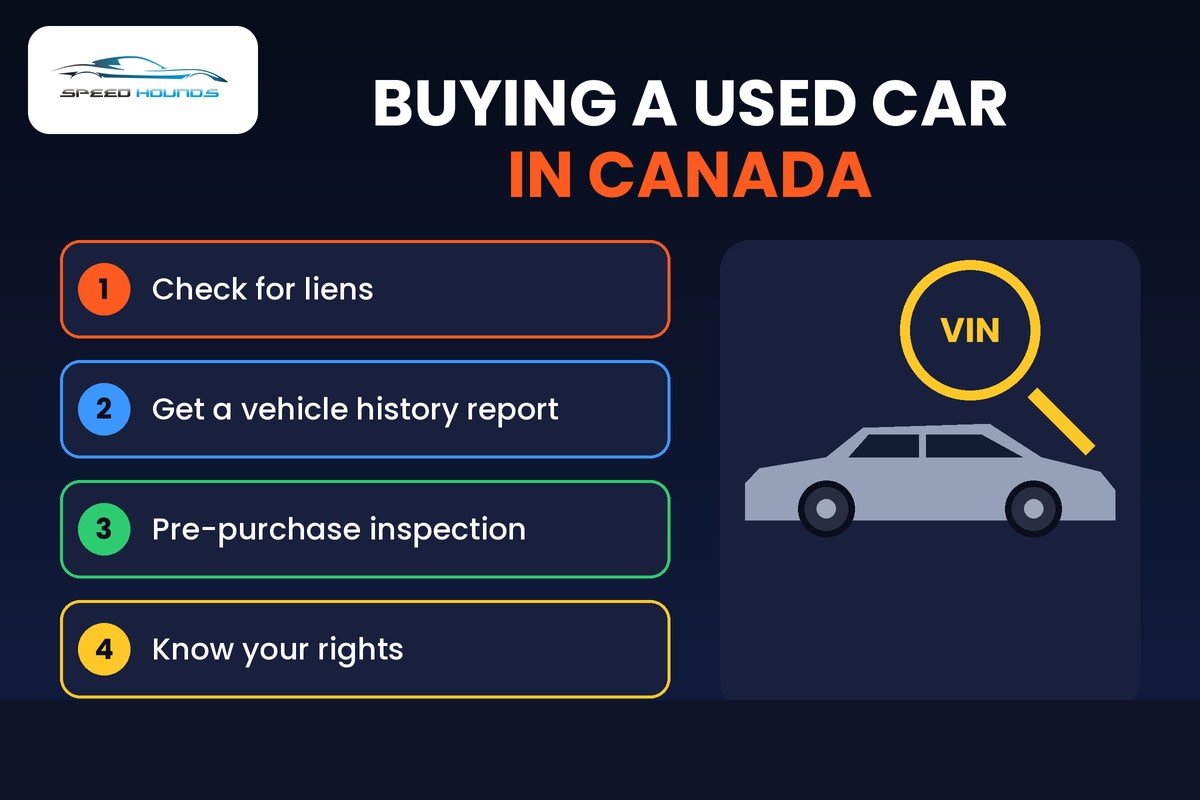
Buying a used car in Canada comes with very different protections depending on whether you buy from a licensed dealer or a private seller, and on which province you live in. Ontario’s vehicle regulator, OMVIC, puts it plainly: its consumer protection law applies only when you buy from a registered dealer. This guide covers the checks that matter in every province and the rules that differ in Ontario, Alberta and Manitoba.
Dealer or private sale: what protection you get
A licensed dealer carries legal duties that a private seller does not. In Ontario, registered dealers must give written disclosure of prior use as a taxi, rental or police vehicle, of damage over $3,000, of branded titles and of the true odometer reading. In Manitoba, licensed dealers must disclose the vehicle’s history and condition in writing before you sign, including whether it was written off and branded salvageable, bought back through CAMVAP, damaged by flood or fire, or used as an emergency, taxi or short-term rental vehicle.
Private sellers in Manitoba are not required to disclose a vehicle’s history, so the checking falls to you. The same logic applies in Ontario, where OMVIC notes buyers from private sellers will not be protected by the dealer legislation. A private sale can still be a good deal, but you carry more of the risk and should do more of the verification yourself.
| Check | Ontario | Alberta | Manitoba |
|---|---|---|---|
| Dealer oversight | OMVIC registration; check the dealer search tool | AMVIC handles questions and complaints about the automotive industry | Dealers must be licensed in Manitoba |
| Ownership and registration history | Used Vehicle Information Package (UVIP), mandatory for private sales | Vehicle information report from a registry agent or AMA | Confirm the registration is in the seller’s name and the VIN matches |
| Liens | UVIP includes lien details; a history report such as CARFAX also flags them | Personal property lien search by VIN through a registry agent | Check the Personal Property Registry (fee applies) |
| Inspection | Safety standards certificate needed when a used vehicle is transferred as fit | Safety inspection at a vehicle inspection facility | Independent mechanic inspection advised |
Step 1: verify the seller and the paperwork
With a private seller, ask to see a driver’s licence and proof of ownership, and confirm the name on the registration matches the person selling. Manitoba’s government advises matching the VIN on the registration to the one on the vehicle, which is usually found at the bottom of the driver’s side of the windshield near the wipers. Alberta’s government also recommends confirming the seller owns the vehicle before any money changes hands.
In Ontario, a private seller must provide a UVIP, which lists ownership history and lien details. Ask for it before you view the car, because a seller who cannot produce one is a red flag.
Step 2: run the history and lien checks
A commercial vehicle history report, such as CARFAX or Carproof, costs money but can reveal unpaid liens and other red flags. OMVIC encourages buyers to get one whether they buy from a dealer or privately. Alberta recommends a personal property lien search by VIN through a registry agent, along with a Carproof report, and Manitoba advises checking the Personal Property Registry.
A lien matters because it is a lender’s claim on the vehicle. If the seller still owes money on it, confirm the lender will release its claim when you pay.
Alberta’s government also points buyers to the Canadian Police Information Centre (CPIC) database to check for stolen vehicles, and notes it does not provide stolen vehicle data itself.
Step 3: get an independent inspection
Manitoba tells buyers to have a trusted independent mechanic inspect any used vehicle first. Alberta recommends a safety inspection at a vehicle inspection facility. In Ontario, a safety standards certificate comes from a government-approved Motor Vehicle Inspection Station, and the province requires one in situations such as transferring a used vehicle to a new owner as fit or registering a vehicle previously registered in another province or country.
A safety certificate shows a vehicle passed an inspection against minimum safety requirements. It is not the same as a full mechanical inspection, so a separate check of the engine, transmission, suspension and rust is still worth the fee, particularly on a vehicle that has spent winters on salted roads.
Step 4: put everything in writing
OMVIC points out that dealer disclosures must be in writing, because verbal assurances are not legally binding. Manitoba’s government gives similar advice: get a salesperson’s promises in writing, find out whether a deposit is refundable, and read the fine print before you sign. Put any conditions, such as a satisfactory pre-purchase inspection, into the contract or bill of sale.
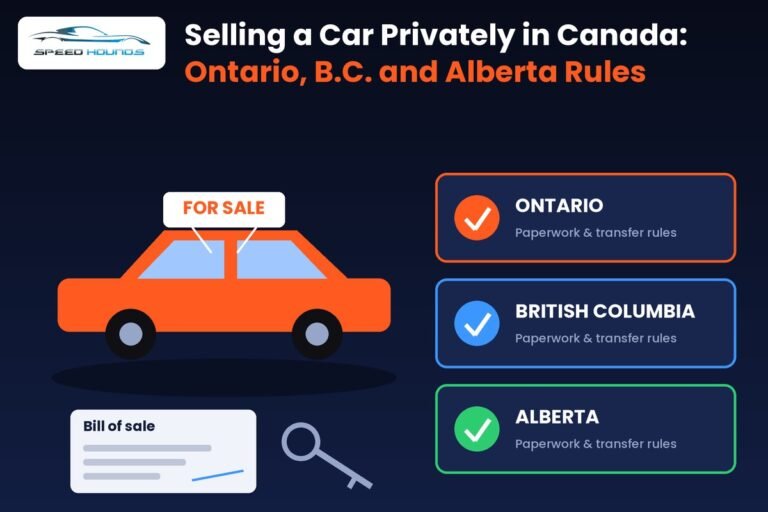
For private sales, a bill of sale should list the vehicle details, the price, HST where it applies, and the names of the buyer and the seller. In Alberta, the government says a standard bill of sale gathers the information the new owner needs to license and register the vehicle.
Step 5: pay safely and transfer ownership
OMVIC advises avoiding cash-only deals, using a traceable payment method and never paying in full before you receive the vehicle. Once the sale is complete, get insurance and register the vehicle as soon as possible. In Alberta, that means visiting a registry agent and confirming the registration certificate matches the proof of ownership and the insurance. Keep the registration, lien history and proof-of-ownership documents in a safe place.
Red flags worth walking away from
A seller who rushes you, refuses a mechanic’s inspection or cannot produce ownership documents should make you cautious. So should a price well below comparable listings, a VIN that does not match the paperwork and a request for a large cash payment up front. Manitoba’s government is direct about it: do not let anyone pressure you, because you can leave at any time.
The rules and fees for registries, inspections and taxes differ across provinces and change over time. Before you buy, check the consumer protection office or vehicle regulator in the province where you will register the car.