How Winter Weather Hurts Fuel Economy in Canada, and What Helps
Canadian drivers notice it every year: the fuel gauge drops faster once the temperature does. Natural Resources Canada explains the reasons in its guidance on factors that affect fuel efficiency, citing U.S. Environmental Protection Agency (EPA) estimates that a drop from 24°C to 7°C can raise fuel use on urban commutes by 12 to 28 per cent. Cold air is only one piece. Dense air, slippery roads, winter-blend fuel and electrical demand all add to the total, and several of them can be managed.
What winter does to fuel use
The table below summarizes the figures Natural Resources Canada publishes for gasoline and diesel vehicles. They are estimates, and the effect on any one vehicle depends on trip length, driving style and conditions.
| Winter factor | Published effect |
|---|---|
| Cold temperatures on short city trips (24°C down to 7°C) | 12 to 28 per cent higher fuel use |
| Denser cold air on the highway | About 1.3 per cent higher fuel use |
| Poor road conditions (snow, ice, slush) | 7 to 35 per cent higher fuel use |
| Winter-blend gasoline | 1.5 to 3 per cent less energy per litre |
| Tires under-inflated by 56 kPa (8 psi) | Up to 4 per cent more fuel, more than 10,000 km of tire life lost |
| Ten minutes of idling | 0.25 to 0.50 litres of fuel burned |
Why cold air costs you fuel
Cold, dry winter air is about 11 per cent denser than summer air. A vehicle moving through denser air meets more resistance, which raises highway fuel use by roughly 1.3 per cent. Wind speeds also tend to be higher in winter, which adds more aerodynamic drag.
The bigger effect shows up in short trips. An engine that has not reached operating temperature uses more fuel, and a driver who makes several short stops a day, such as a school run and a commute, may spend much of the journey with a cold engine.
Roads, fuel and electrical load
Snow, ice, slush and rougher pavement increase rolling resistance and wheel slippage. EPA data cited by Natural Resources Canada put the increase from poor road conditions alone at 7 to 35 per cent. That wide range is a reminder that a freshly ploughed highway and an unploughed side road are very different driving environments.
Winter gasoline also carries slightly less energy. The agency says it holds about 1.5 to 3 per cent less energy per litre than summer gasoline, and diesel is affected in a similar way. You cannot choose a different blend at the pump, but it explains part of the drop you see in winter fuel economy.
Finally, heating and defrosting systems, lights, heated seats, heated mirrors and the washer pump all increase the electrical load. The engine supplies that power, so using these features more often in cold weather uses more fuel.
Idling: the habit with no benefit
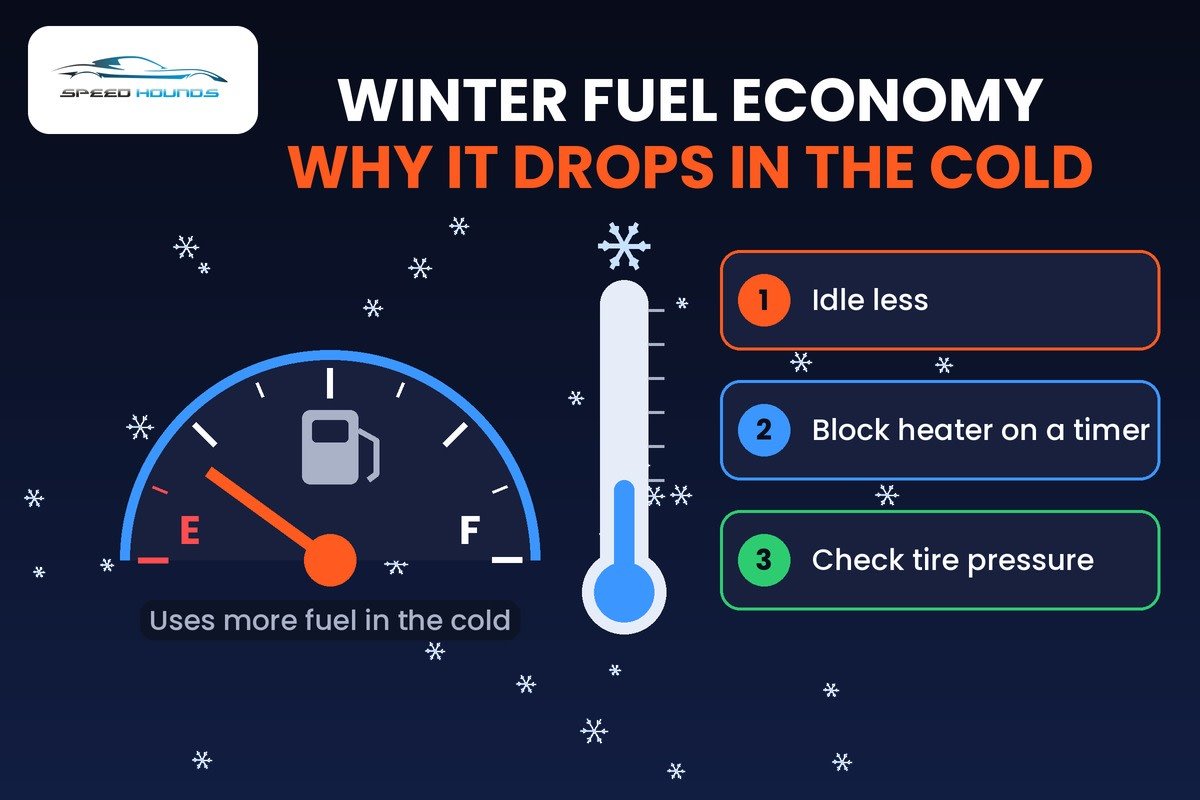
Natural Resources Canada states that idling for more than 30 seconds has no benefit for the vehicle. Ten minutes of idling burns 0.25 to 0.50 litres of fuel and emits 600 to 1,200 grams of carbon dioxide, depending on the vehicle and conditions. The agency says driving for a few minutes is the most efficient way to warm the engine, drivetrain and cabin.
To see how it adds up, take a hypothetical driver who idles for 10 minutes each morning on 100 winter days. That is 25 to 50 litres of fuel for no gain. At an illustrative $1.50 per litre, the cost would be roughly $37 to $75 over the season. Your own pump price will change the number, but not the logic.
Use a block heater with a timer
A block heater warms the engine before you start it. Natural Resources Canada says this shortens the period of fuel-enriched combustion during warm-up, which lowers fuel use and emissions. The recommended way to use one is with a timer set to start the heater no more than two hours before you drive. Plugging in overnight is not necessary, and a timer avoids paying to heat the engine for hours it does not need.
Check tire pressure more often
Tire pressure falls as temperatures fall, which is why winter is the season when many drivers find a warning light on the dash. Natural Resources Canada recommends checking pressure at least monthly, and more often when the seasons change.
The stakes are real. Driving on tires under-inflated by 56 kPa, or 8 psi, can raise fuel use by up to 4 per cent and cost more than 10,000 km of tire life. For a driver who burns 500 litres of fuel over the winter months, a 4 per cent penalty would be about 20 litres. Use the pressure listed on the sticker inside the driver’s door, not the maximum printed on the tire sidewall, and check when the tires are cold. A portable gauge or a quick stop at a station with a working air pump takes only a few minutes and costs far less than the extra fuel.
A practical winter checklist
- Keep idling to 30 seconds or less, then drive gently until the engine warms up.
- Combine short errands into one trip so the engine stays warm.
- Put your block heater on a timer, set to start about two hours before departure.
- Check tire pressure at least monthly and after any sharp temperature change.
- Clear snow and ice from the vehicle before you leave rather than warming it up with the engine running.
- Plan for slower speeds on poor roads, since slippage and rolling resistance both raise fuel use.
What this means for Canadian drivers
Winter fuel economy is not a single number you can fix with one habit. Cold weather, road conditions and fuel blend are largely out of your hands, but idling, tire pressure and block heater use are choices that cost nothing or very little. Together they can recover a meaningful share of the extra fuel the season demands.
The figures here apply to gasoline and diesel vehicles. If you drive a hybrid, plug-in hybrid or electric vehicle, check the ratings and cold-weather guidance from the manufacturer and from Natural Resources Canada’s fuel consumption ratings for your specific model.