Hydrogen Truck Crosses the Rockies, 1,046 km From Vancouver to Calgary
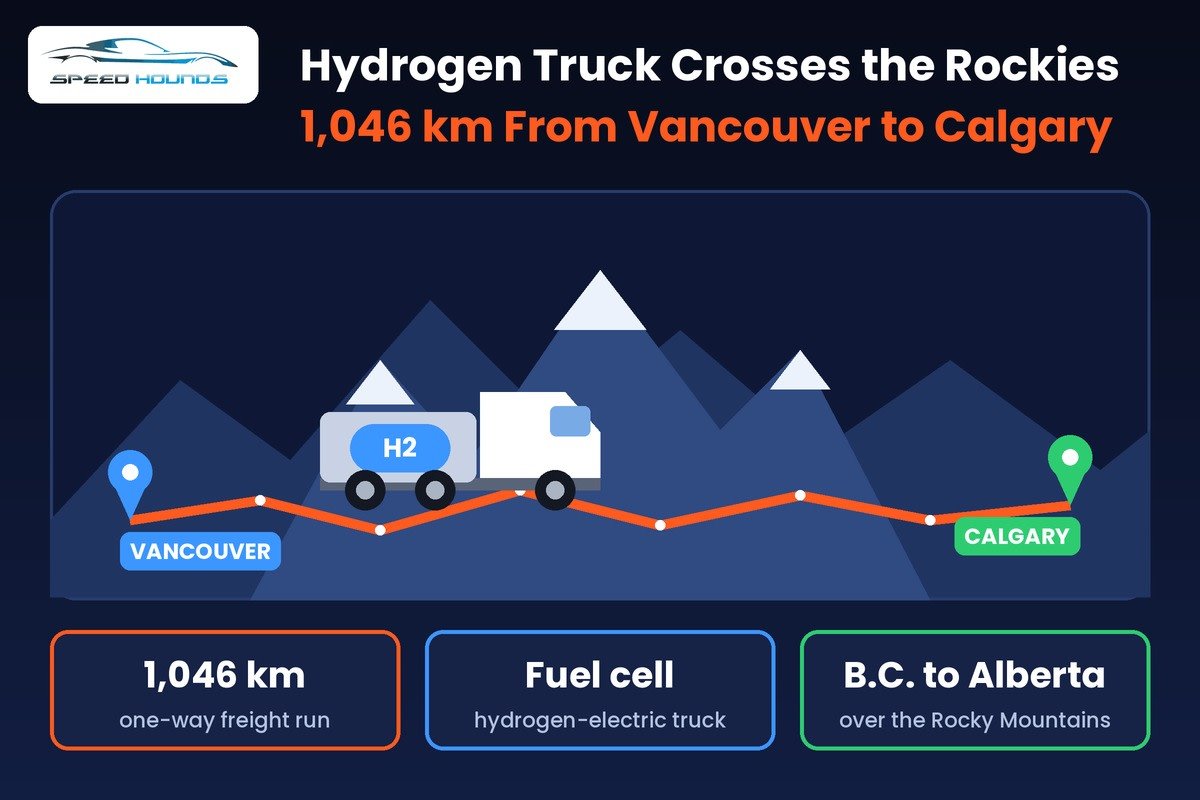
A hydrogen fuel-cell truck has hauled freight 1,046 km through the Rockies from Vancouver to just north of Calgary, Electric Autonomy reports, with no permanent hydrogen station along the way. The test, run over two days, used a mobile refuelling trailer to keep a Hyundai Xcient Class 8 truck moving for retailer Loblaw.
The route and the truck
The truck is owned by hydrogen supplier HTEC and leased to Loblaw Companies. It drove from Vancouver to Loblaw’s site at Balzac, Alta., via the Coquihalla Highway, Rogers Pass and Kicking Horse Canyon. The trip climbed a cumulative 8,783 m, with a maximum grade of 8.4 per cent on Rogers Pass, in cold weather.
| Test detail | Figure |
|---|---|
| Distance | 1,046 km over two days |
| Cumulative climb | 8,783 m |
| Steepest grade | 8.4% (Rogers Pass) |
| Claimed range at full load | Up to 720 km (Hyundai, North American spec) |
| Refill time | Under 20 minutes |
How it refuelled with no stations
Powertech Labs, a BC Hydro subsidiary, brought a mobile trailer holding 1,050 kg of hydrogen at 517 bar. It fuelled the truck at Sicamous, B.C., on day one, then moved to Golden, B.C., for day two. Only six permanent HTEC stations operate in southern B.C., so the mobile approach was the test’s workaround for a corridor that has none.
The article contrasts the sub-20-minute fill with traditional battery-electric truck charging of one to two hours, though newer megawatt systems promise significant range in under an hour. It adds that earlier electric trucks managed roughly half of the Xcient’s claimed range, and notes the Tesla Semi exceeds 800 km.
What it costs in Canada
Hydrogen sells for about $16.50 per kilogram in Vancouver. One kilogram carries roughly the energy of 3.3 L of diesel, and diesel in Vancouver is above $1.80 per litre, which puts the diesel energy equivalent at about $5.94. Fuel-cell efficiency differs from a diesel engine’s, so the per-kilometre gap is narrower than those figures suggest, and the project’s fuel analysis will test it.
The truck itself is the bigger hurdle: fuel-cell Class 8 trucks generally cost up to 2.5 times a comparable diesel. British Columbia’s Go Electric BC program offers $130,000 per zero-emission vehicle to commercial organizations and $156,000 to Indigenous and non-profit organizations and municipalities.
Who is behind it and what comes next
The pilot was organized by the Edmonton Region Hydrogen Hub as part of the Western Canada Hydrogen Corridors Initiative. Funding came from FortisBC’s Clean Growth Innovation Fund, Alberta Innovates, the Alberta Ecotrust Foundation, Emissions Reduction Alberta and the hub itself. Telematics and fuel consumption data are still being analyzed, with a report expected by the end of January 2027. A shorter Loblaw and FortisBC demonstration ran from Vancouver to Squamish in November 2025.
For everyday drivers this is a freight story, not a showroom one: hydrogen cars face the same thin station network. Our powertrain primer for Canada explains where fuel-cell vehicles fit next to battery and hybrid options, and the auto technology briefing on Hyundai hydrogen covers the maker’s wider push. For charging policy on the battery side, see Budget 2026’s $634 million for EV charging.