Car Depreciation in Canada: Which Vehicles Hold Their Value
A new vehicle starts losing value the day it leaves the lot, and the size of that loss is often the largest single cost of owning it. Canadian Black Book (CBB), the industry’s main valuation source, ranks models every year on how well they hold their price, and its 2026 residual value awards show a market where Toyota dominates and electric vehicles are still finding their footing.
Last updated November 2026
How retained value is measured
Depreciation is the difference between what a vehicle cost new and what it sells for later. Analysts usually flip that around and talk about retained value: the share of the original MSRP a vehicle is still worth after a set period. CBB’s awards use four years as the yardstick. Toyota Canada’s release on the 2026 Best Retained Value Awards says the program looked at 2023 model-year vehicles across 16 vehicle categories plus four overall brand categories, and rewarded the ones that kept the highest percentage of their original MSRP.
A simple example shows why this matters. A vehicle with a $40,000 MSRP that retains 60 per cent after four years is worth $24,000, so the owner has absorbed $16,000 of depreciation, or about $4,000 a year. A rival that retains 50 per cent has cost $20,000 over the same period. Those percentages are an illustration, not CBB figures, but the arithmetic is the same for any price tag. The gap between a strong and a weak performer can easily exceed what a buyer saves by negotiating at the dealership.
What the 2026 awards say about who holds value
CBB announced its 2026 residual value awards on February 12, 2026, ahead of the Canadian International AutoShow. Toyota took the Overall Brand awards for both cars and SUVs/trucks. Porsche won the luxury brand award, Kia took the electric brand award and Volkswagen was named most improved. Toyota Canada says it won eight awards in total, including a tenth consecutive overall mainstream brand win, an 18th consecutive win for the Tacoma in the small and mid-size pickup category and a fourth straight for the Tundra among full-size pickups.
The category winners listed on CBB’s page include several vehicles shoppers will recognize:
| Category | 1st | 2nd | 3rd |
|---|---|---|---|
| Small/mid-size pickup | Toyota Tacoma | Ford Maverick | GMC Canyon |
| Full-size pickup | Toyota Tundra | Ram 1500 | Chevrolet Silverado |
| Mainstream mid/full-size SUV | Toyota Sienna | Toyota Highlander | Toyota Grand Highlander |
| Mainstream compact/subcompact SUV | Chevrolet Trax | Subaru Crosstrek | Hyundai Tucson |
| Mainstream plug-in hybrid | Kia Sorento PHEV | Toyota Prius PHEV | Hyundai Tucson PHEV |
| Mainstream electric SUV/truck | Hyundai Kona EV | Chevrolet Equinox EV | Hyundai Ioniq 9 |
Source: Canadian Black Book, February 2026. CBB’s residual awards are based on its proprietary forecasting models, which weigh historical depreciation trends, market conditions, brand strength, and supply and demand, and they project residual values out to 2030. Toyota’s separate retained value release names different winners in a few categories, so shoppers comparing the two programs will see small differences at the top of the car and plug-in hybrid lists.
Why electric vehicles have lagged
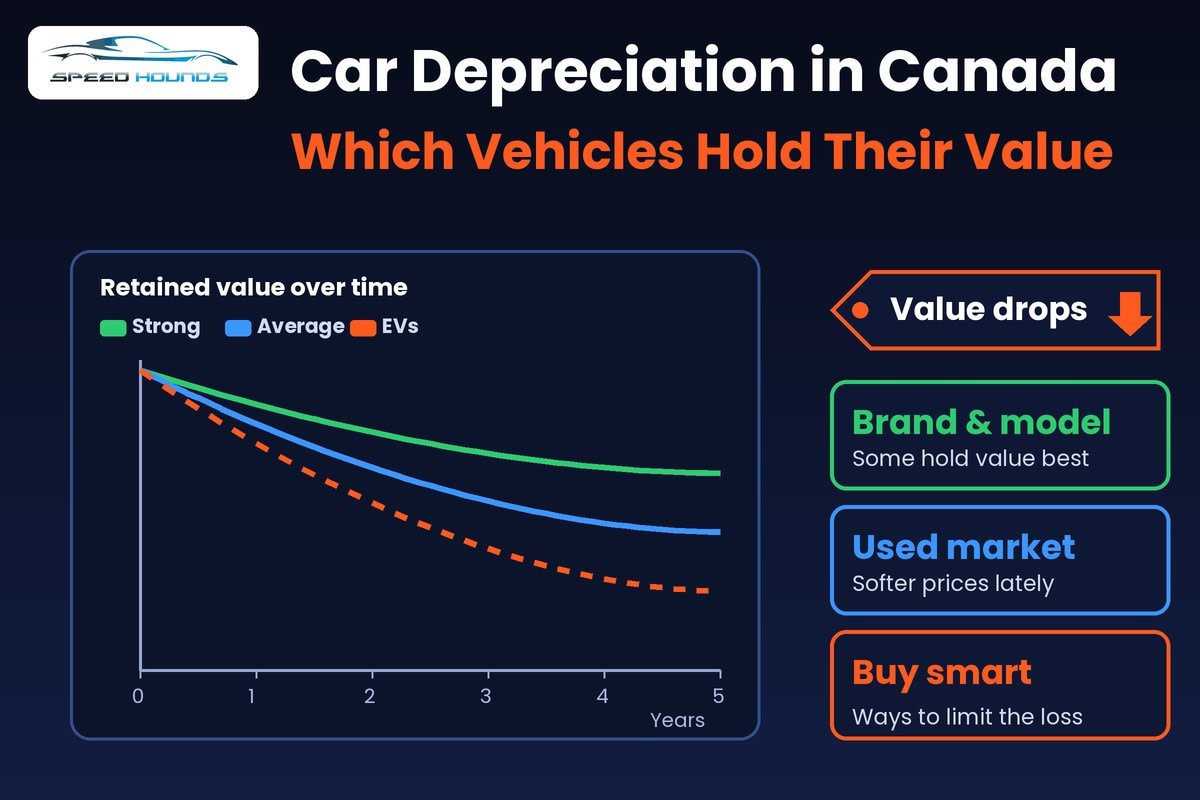
CBB and Fitch Ratings’ 2025 depreciation report found that battery-electric vehicles posted the biggest drop in four-year retained value of any fuel type in 2024, at 14 per cent year over year, almost double the market average. The report says battery-electric vehicles trail gas and hybrid models in both value retention and demand. It also expects the supply of used EVs to roughly double and then double again by 2027, which will keep pressure on prices even as some models recover.
The same report shows how uneven the market is. Average annual depreciation was 15.8 per cent in 2023 and 15.5 per cent in 2024, against an average of 12.2 per cent in the nine years before COVID-19. Prestige luxury cars lost the most in 2024 at 32.1 per cent, followed by luxury cars at 23.0 per cent. Among the 13 light truck segments, eight depreciated faster than the market average, while two of nine passenger car segments did.
For Canadian EV buyers, the federal rebate changes the starting point. Under the federal EVAP program, the rebate is $5,000 for battery-electric and fuel cell vehicles and $2,500 for plug-in hybrids in 2026, falling to $4,000 and $2,000 on January 1, 2027. The $50,000 transaction value cap does not apply to vehicles made in Canada. Our guide to EV rebates in Canada explains how the dealer submission date decides which amount you receive. The rebate lowers what you pay, but it does not change how the market values the vehicle later, so the real cost of ownership depends on both.
What is happening to used prices right now
Used values have been softening. CBB reported that Canadian wholesale prices fell 0.40 per cent in the week ending October 24, 2026, after a 0.27 per cent decline the week before, and put the average retail asking price at about $37,900. Mid-size cars fell 1.01 per cent and subcompact crossovers 0.96 per cent in CBB’s October 27 report. Wholesale moves do not pass straight through to dealer lots, a point we covered in our report on Canadian used-car wholesale values, but a falling market means trade-in offers tend to drift lower too.
Practical ways to limit the loss
The biggest drop happens early, which is why many shoppers look at vehicles two or three years old. BrokerLink advises keeping mileage low, maintaining the vehicle on schedule and selling or trading in before five years or 100,000 km. The first two points are within your control, and the third is a timing decision worth planning for before you sign a loan or lease term. Our used car buying guide covers the history reports and lien checks that protect you when you buy on the other side of that curve.
Provincial sales tax adds a second layer. GST or HST, and PST in some provinces, is charged on the price you pay and is not recovered when you sell, so a $40,000 vehicle in Ontario carries $5,200 of HST at 13 per cent that is part of your cost from day one. That tax is another reason to weigh the length of time you plan to keep the vehicle against the purchase price. When it is time to sell, the rules differ between a private sale and a trade-in, and our guide to selling a car privately in Canada lays out the paperwork in Ontario, B.C. and Alberta.
Finally, brand and body style matter as much as the model year. Pickups and large family vehicles from established brands have done well in the awards, while prestige luxury cars and battery-electric vehicles posted the steepest losses in CBB’s 2024 data. If resale value matters to you, check the CBB category lists before you shop, then compare the likely loss against the total running costs in our five-year cost breakdown for a $40,000 car.