Child Car Seat Laws in Canada: Rules by Province and Territory
Child car seat laws in Canada work in two layers. Transport Canada sets the safety standards a seat must meet, and each province and territory decides which children must use a car seat or booster. The age, weight and height limits differ by jurisdiction, so the table below sets out the rules for the 10 provinces and 3 territories.
Last checked November 12, 2026. Rules and programs change, so confirm details with the official source linked below before you act.
Federal standards and provincial use rules
Transport Canada sets the Canada Motor Vehicle Safety Standards (CMVSS) for child car seats and booster seats. Any child seat or booster used in Canada must comply with the Motor Vehicle Safety Act and the applicable CMVSS, and the seat should carry the National Safety Mark. Transport Canada explains the requirements on its page on safety standards for child car seats.
The federal standards cover design and compliance. They do not say when a child must sit in a particular seat. That falls to the provinces and territories, which set use laws, penalties and the point at which a child can switch to an adult seat belt.
Child car seat rules by province and territory
The table summarizes the requirement in each jurisdiction as published by the responsible government body. Each link goes to the official page for that jurisdiction.
| Jurisdiction | What applies | Details | Source |
|---|---|---|---|
| Ontario | Appropriate restraint required for children under 8 | Rear-facing up to 9 kg; forward-facing 9–18 kg; booster 18–36 kg and under 145 cm. A seat belt alone is allowed when the child reaches any one of age 8, 36 kg or 145 cm. Conviction brings a $240 fine and 2 demerit points. | Official page |
| Quebec | Child seat or booster until 145 cm or 9 years of age | The requirement ends when the child meets whichever comes first. In force since April 2019. The SAAQ page was last updated December 16, 2024. | Official page |
| British Columbia | Booster seat until the child reaches 145 cm | Set out in Division 36 of the Motor Vehicle Act Regulations. | Official page |
| Alberta | Child safety seat for children under 6 who weigh 18 kg (40 lb) or less | Booster seats are not required by law. The fine for occupant restraint violations is $211. | Official page |
| Saskatchewan | Approved car seat or booster for children under 7 | SGI states that boosters are mandatory for children under 7 who are also under 145 cm and under 36 kg. SGI dates the booster requirement to June 27, 2014. | Official page |
| Manitoba | Booster for passengers under 9 years, under 36 kg and under 145 cm | Governed by M.R. 89/2013. The booster must be used with a seat belt and according to the manufacturer’s instructions. | Official page |
| New Brunswick | Booster from 18 kg until the child reaches one of age 9, 36 kg or 145 cm | Minimum fine is $172.50. Rental vehicles must comply. | Official page |
| Nova Scotia | New Traffic Safety Act took effect October 19, 2026 | Rear-facing for a child under 2 years or under 10 kg. Harnessed seat for a “young child” at least to age 4 or under 18 kg. Booster for an “older child” at least 4 and under 9, at least 18 kg and under 145 cm. | Official page |
| Newfoundland and Labrador | Approved booster for children 18–37 kg (40–80 lb) who are 145 cm (4’9″) or less | The booster law took effect July 1, 2008. | Official page |
| Prince Edward Island | Booster required by law since January 1, 2008 | Criteria are a child of at least 18 kg, 9 years or younger, and under 145 cm. Use continues until the child is over 9 or at least 145 cm. | Official page |
| Yukon | Rear-facing, then harness, then booster | Rear-facing to at least 10 kg and until the child walks unassisted; 5-point harness until 22 kg; booster until at least 145 cm or 45 kg, whichever comes first. Page last updated May 19, 2026. | Official page |
| Northwest Territories | Drivers must ensure passengers under 15 are properly restrained | Children under 6 and 18 kg or less must be in an appropriate child safety seat. The regulations adopt the CMVSS. | Official page |
| Nunavut | Traffic Safety Act requires a passenger of a prescribed size or weight to be secured in a prescribed child restraint | Specific size and weight thresholds: Not confirmed in the official sources checked. | Official page |
How the booster thresholds compare
A height of 145 cm appears in the booster rules of many jurisdictions, often alongside a weight of 36 kg or an age of 9. The way those limits combine is not the same everywhere, and the difference decides when a child can move to a seat belt.
In Quebec, the requirement ends at 145 cm or 9 years of age, whichever comes first. New Brunswick works the same way with three triggers: age 9, 36 kg or 145 cm, whichever the child reaches first. Ontario also allows a seat belt alone once a child reaches any one of age 8, 36 kg or 145 cm. Manitoba’s regulation describes a booster passenger as under 9 years, under 36 kg and under 145 cm. British Columbia uses height alone, at 145 cm. Yukon sets its booster limit at 145 cm or 45 kg, whichever comes first.
Alberta stands apart. Its law requires a child safety seat for children under 6 who weigh 18 kg (40 lb) or less, and it does not require booster seats. Saskatchewan’s current Driver’s Handbook says children under seven must be properly fitted in an approved seat, and SGI’s backgrounder supplies the 145 cm and 36 kg limits.
Two entries carry extra notes. Nova Scotia’s Traffic Safety Act took effect on October 19, 2026, and the province explains the new child restraint definitions on its traffic safety legislation page. In Prince Edward Island, the consolidated Seat Belt Regulations do not clearly show the booster amendment on their own. An Executive Council document, EC2007-622/642, confirms the booster provisions were in force January 1, 2008.
What agencies recommend beyond the law
Several agencies advise more than the legal minimum. These are recommendations, not legal requirements.
- Transport Canada recommends following the manufacturer’s instructions and respecting a seat’s expiry or useful-life date. Many seats carry an expiry date, though one is not required federally. Its guidance on choosing a child car seat or booster seat covers the details.
- The SAAQ in Quebec recommends keeping a child in a booster until the child reaches the seat’s maximum height or weight, even though the law allows a seat belt at 9 years or 145 cm. It also recommends that children 12 and under ride in the back seat.
- Alberta recommends booster seats even though the law does not require them, and recommends that children 13 and older ride in the back seat.
- Yukon recommends replacing a car seat after any collision and getting help from certified technicians through the territorial program.
Transport Canada also notes that a child can legally use a seat belt once the child reaches the limits set by the provincial or territorial regulations. Check the official page for your jurisdiction in the table, especially in Nova Scotia, where the rules changed on October 19, 2026.
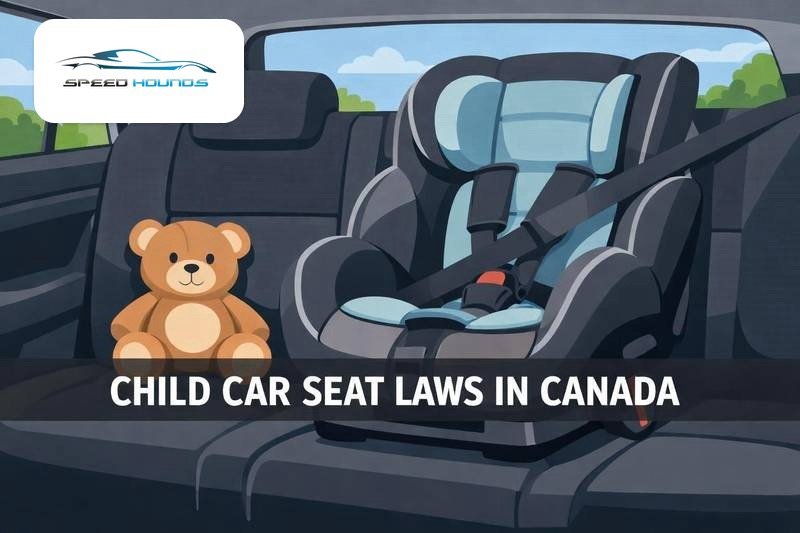
Featured image: AI-generated illustration.