EnerGuide Label in Canada: How to Read Fuel Ratings and Costs
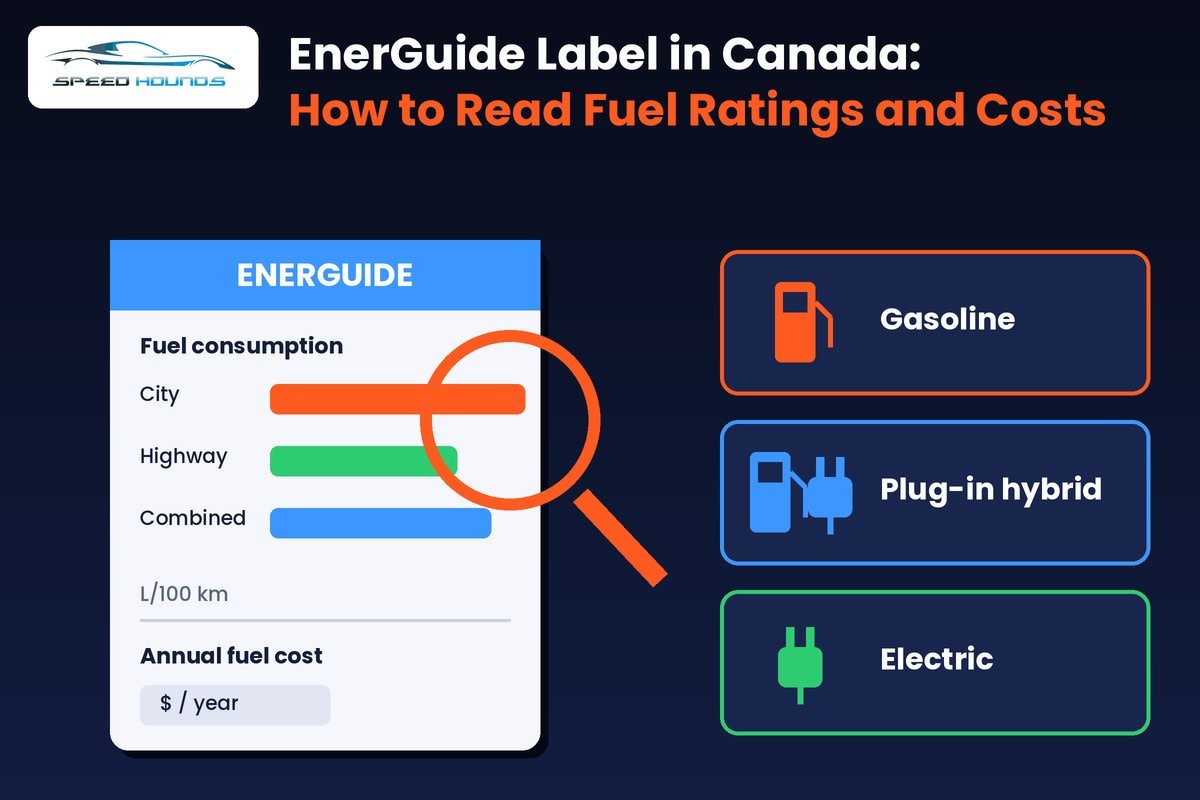
The EnerGuide label on a new vehicle in Canada is the quickest way to compare fuel use between models, but only if you know what its numbers measure. Natural Resources Canada explains the label on its EnerGuide for vehicles page, and the figures behind it come from standardized laboratory testing rather than from a drive on a real road.
What the EnerGuide label is and where you see it
EnerGuide labels apply to new light-duty vehicles sold in Canada, including passenger cars, vans, pickups and SUVs. NRCan says the label should stay on the vehicle until it is sold. If a new vehicle on a dealer’s lot has no label, the dealer can supply the manufacturer’s fuel consumption information.
Some heavy vehicles are exempt from testing and do not appear on the label or in NRCan’s search tool. Those include SUVs and passenger vans at 4,536 kg (10,000 lb) gross vehicle weight rating or more, pickups over 3,856 kg (8,500 lb) with an interior bed length of 183 cm (72 in) or more, and cargo vans over 3,856 kg.
How to read a gasoline vehicle label
The gasoline label has seven main elements, according to NRCan.
| Label element | What it tells you |
|---|---|
| Vehicle technology and fuel | The fuel type, shown in text and with an icon |
| Fuel consumption | A combined rating in litres per 100 km, plus separate city and highway ratings. The combined figure reflects 55 per cent city and 45 per cent highway driving |
| Fuel economy | The combined rating expressed in miles per imperial gallon |
| Annual fuel cost | An estimate based on the combined rating, 20,000 km of driving a year and the fuel price printed on the label |
| Vehicle class range | The best and worst combined ratings among vehicles in the same class |
| CO2 and smog ratings | Tailpipe CO2 in grams per km, and a smog rating from 1 (worst) to 10 (best) |
| QR code | A link to NRCan’s fuel consumption ratings search tool |
The class range is useful because a 9.0 L/100 km rating means something different for a compact car than for a three-row SUV. Comparing within the class shows whether a vehicle is efficient for its size. Because the annual cost uses the fuel price printed on the label and a fixed 20,000 km, treat it as a comparison tool between vehicles. Your own cost depends on current pump prices and how far you drive.
Plug-in hybrid and electric labels
Electric vehicles do not burn litres of fuel, so NRCan converts electricity use into a gasoline equivalent. The agency states that one litre of gasoline holds the energy equivalent of 8.9 kWh of electricity. That conversion lets a battery-electric vehicle be rated in Le/100 km (litres of gasoline equivalent per 100 km), which is the same unit used to compare it with a gasoline model.
| Label type | Main figures shown |
|---|---|
| Battery-electric | Combined, city and highway consumption in Le/100 km, the combined rating in kWh/100 km, estimated recharge time at 240 volts, and estimated range on a full battery |
| Plug-in hybrid (series) | Electric-only combined rating in Le/100 km and kWh/100 km, a separate gasoline-only rating in L/100 km, recharge time at 240 volts, and range on a full charge plus a full tank |
| Plug-in hybrid (blended) | A combined blended-mode rating in Le/100 km built from gasoline and electricity use, a gasoline-only rating, recharge time at 240 volts, and range on a full charge plus a full tank |
For a plug-in hybrid, NRCan notes that annual fuel cost and CO2 reflect a mix of electric mode and gasoline-only operation. How close you come to that mix depends on how often you plug in. A driver who charges nightly will see a different result from one who rarely does.
Recharge time on both electric label types is stated for a 240-volt supply, the kind of circuit used for a home Level 2 charger. It is not a measure of public fast-charging speed.
How the ratings are produced
NRCan says the ratings come from controlled tests run by manufacturers, because driving every model on public roads would be impractical and the results could not be repeated with changing weather and traffic. Environment and Climate Change Canada collects the data. NRCan then publishes it in the Fuel Consumption Guide and the fuel consumption ratings search tool, and the same data feeds the label.
Before model year 2015, manufacturers used a two-cycle procedure that simulated city and highway driving. They now use a five-cycle procedure that adds cold-weather operation, air conditioner use, and higher speeds with harder acceleration and braking. The vehicle is driven about 6,000 km to break it in, then placed on a chassis dynamometer, described by NRCan as a treadmill for vehicles, that is set for the vehicle’s weight and aerodynamics.
| Test cycle | Conditions | Distance | Average speed |
|---|---|---|---|
| City | Cold start, 20 to 30 C | 17.8 km | 34 km/h |
| Highway | Hot start, 20 to 30 C | 16.5 km | 78 km/h |
| Cold temperature | City cycle repeated at -7 C | 17.8 km | 34 km/h |
| Air conditioning | Test cell at 35 C, cabin cooled | 5.8 km | 35 km/h |
| High speed, quick acceleration | Warm start, no air conditioning, top speed 129 km/h | 12.9 km | 78 km/h |
NRCan describes the five-cycle results as more representative of on-road consumption than the old two-cycle numbers. It does not claim they match every driver’s experience. It also notes that an engine does not reach maximum efficiency until it is warm, which is why the cold-start and cold-temperature cycles exist.
Why your own numbers will differ
The label figure is a benchmark, not a promise. Winter driving at temperatures well below the -7 C test point, short trips that never let the engine warm up, towing, roof racks, aggressive acceleration and heavy air conditioner use can all push real-world consumption above the label. A long, steady highway run in mild weather can come in below it. Electric and plug-in hybrid vehicles are affected too, since cold weather and cabin heating draw on the battery.
NRCan also notes that ratings for 2017 and later models may differ slightly from 2016 ratings for the same vehicle, because some manufacturer calculations were changed to better reflect hybrids and turbocharged engines. Compare vehicles using ratings from the same model year where possible.
A simple way to use the label when shopping
Start with the combined figure and the class range to see how a vehicle sits against its peers. Then look at the highway or city rating that matches most of your driving. For a plug-in hybrid or electric vehicle, check the recharge time and range alongside the consumption rating, and think about whether you can charge at home. Finally, use the QR code or the NRCan search tool to line up two or three models side by side before you visit a dealer.