Home EV Charging in Canada: Level 1 vs Level 2 Guide
Over 80 per cent of electric vehicle owners charge at home, often overnight, according to Natural Resources Canada. For most drivers, home charging is the main way to keep an EV or plug-in hybrid topped up, which makes the choice between a standard outlet and a dedicated 240-volt charger one of the biggest decisions of ownership.
Level 1 and Level 2 charging
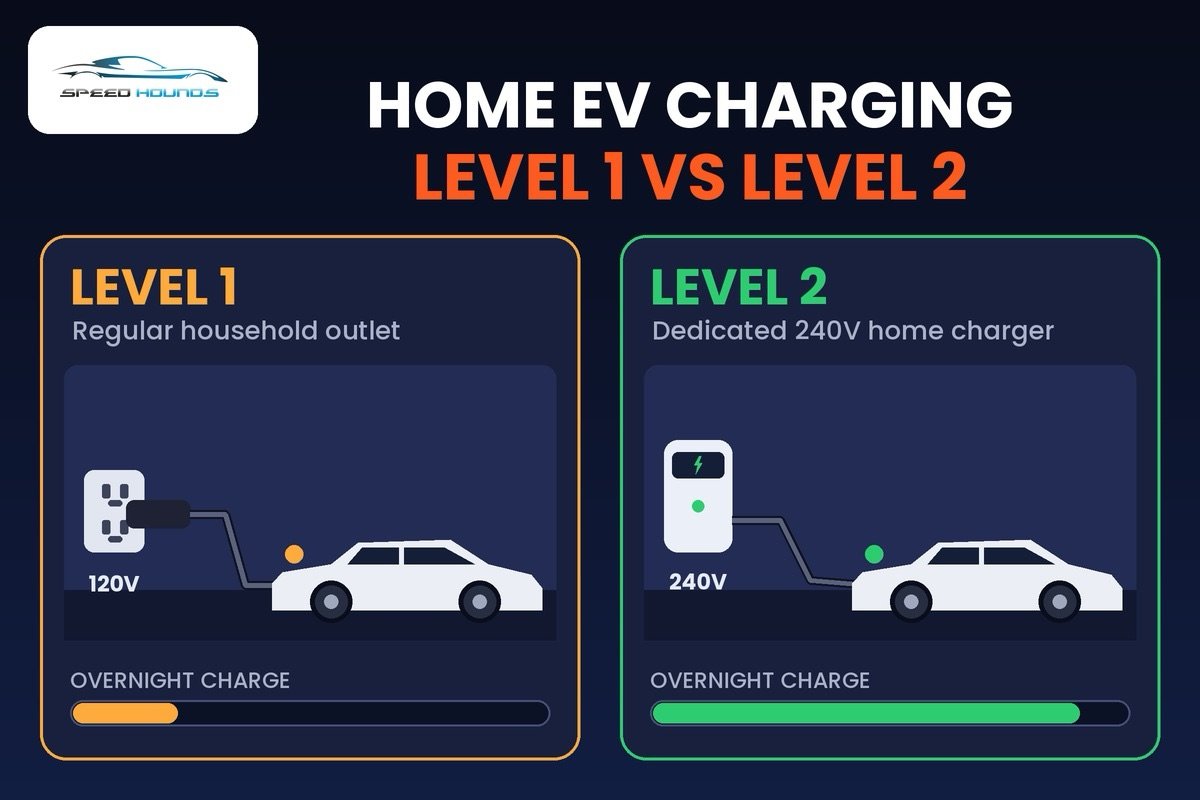
Natural Resources Canada divides home charging into two AC options. Level 1 uses a standard 120-volt wall outlet and a cord that is included with the vehicle. It adds roughly 3 to 8 km of range per hour of charging. Level 2 needs a 208 or 240-volt circuit, the same kind used by dryers and ovens, and adds 16 to 97 km of range per hour, depending on the vehicle.
DC fast chargers, known as Level 3, are the fastest option but are found in public places and businesses. Natural Resources Canada says they are not suitable for home installation.
How long does it take to recharge?
NRCan notes the average Canadian drives about 20,000 km a year, or roughly 55 km a day. The table applies its range-per-hour figures to that daily distance. These are our calculations from the published ranges, not manufacturer ratings, and your vehicle’s real speed will fall somewhere in each range.
| Charger | Range added per hour (NRCan) | Time to add 55 km |
|---|---|---|
| Level 1 (120 V) | 3 to 8 km | About 7 to 18 hours |
| Level 2 (240 V) | 16 to 97 km | About 35 minutes to 3.5 hours |
At the slow end, Level 1 charging may not keep up with a long commute or a large battery. At the fast end, a Level 2 charger can restore a typical day of driving in well under an hour. Drivers with short trips and a long overnight window may find Level 1 enough, while frequent drivers are better served by Level 2.
What installing a Level 2 charger involves
In most jurisdictions a Level 2 charger must be installed by a licensed electrician. The electrician can help you choose a unit, check whether your electrical panel has enough capacity and whether it needs an upgrade, and submit the required permits on your behalf.
Cost depends on the charger itself, your home’s electrical capacity, permit requirements and local labour rates, so quotes vary widely between homes. A 240-volt setup costs more up front than using an existing outlet, but charges much faster.
When you shop for a charger, look for these features:
- Safety certification. Natural Resources Canada warns that uncertified chargers can cause injury or property damage.
- An outdoor rating if your parking space is outside or open to the weather.
- Wi-Fi connectivity. Smart chargers let you monitor use and schedule charging in off-peak hours to reduce electricity costs, where your utility offers time-based rates.
- A hardwired or plug-in design that matches your garage or driveway layout.
Incentives for home chargers
Some provinces offer rebates of up to 50 per cent of the installation cost of a home charger. Some programs require pre-approval before work begins, so check with your provincial energy provider before you book an electrician. In British Columbia, BC Hydro lists rebates of up to 50 per cent on eligible Level 2 chargers, with an extra $250 available for a qualifying Peak Saver device and program enrolment. Programs and amounts change, so confirm current terms with your provider.
Charging at home in a Canadian winter
Cold weather affects both range and charging. BC Hydro says drivers can expect 20 to 40 per cent less range in sub-zero conditions, and that the battery charges more slowly when it is cold. Cabin heat and seat warmers draw further on the battery.
These steps can help:
- Precondition the cabin while the car is still plugged in. The heat then draws from the charger rather than the battery, which preserves range for the drive.
- Keep the charge port and connector clear of snow and ice, wipe them dry and avoid forcing a frozen latch.
- Check tire pressure when the tires are cold. BC Hydro says correct pressure can add up to 10 per cent to range.
- Carry a weatherproof cable or extension cord that is rated for Canadian winter use and approved by the vehicle manufacturer.
If you park outdoors, an outdoor-rated charger matters more in winter than in summer. A garage helps, but it is not required.
Portable and wall-mounted chargers
Natural Resources Canada notes that chargers come in portable and wall-mounted forms. A portable unit plugs into a standard outlet and can travel with the vehicle, which suits Level 1 charging and occasional use away from home. A wall-mounted charger is fixed in place, usually on a dedicated 240-volt circuit, and tends to suit daily charging in a garage or on an exterior wall.
Before choosing, think about where the cable will reach, how far the parking space is from the electrical panel and whether you may change vehicles. A longer run between the panel and the charger can affect the work involved, which is one more reason to get a written quote that reflects your actual layout. Ask the electrician which model they recommend for your climate, and keep the installation paperwork, since some rebate programs and insurers ask to see it.
Choosing between Level 1 and Level 2
A simple way to decide is to compare your daily driving with the hours the car sits parked. If you drive about 55 km a day and the car is plugged in for 12 hours or more, even a slower Level 1 charger may cover your needs most days. If you drive more, own a larger battery, or want to precondition and recharge quickly in winter, a Level 2 charger is the more flexible choice.
Whichever you choose, ask a licensed electrician to look at your panel first. It is the best way to know what the job will cost and whether a rebate is available before you commit.