U.S. Share of Canada’s Vehicle Imports Falls to 40% in 2026
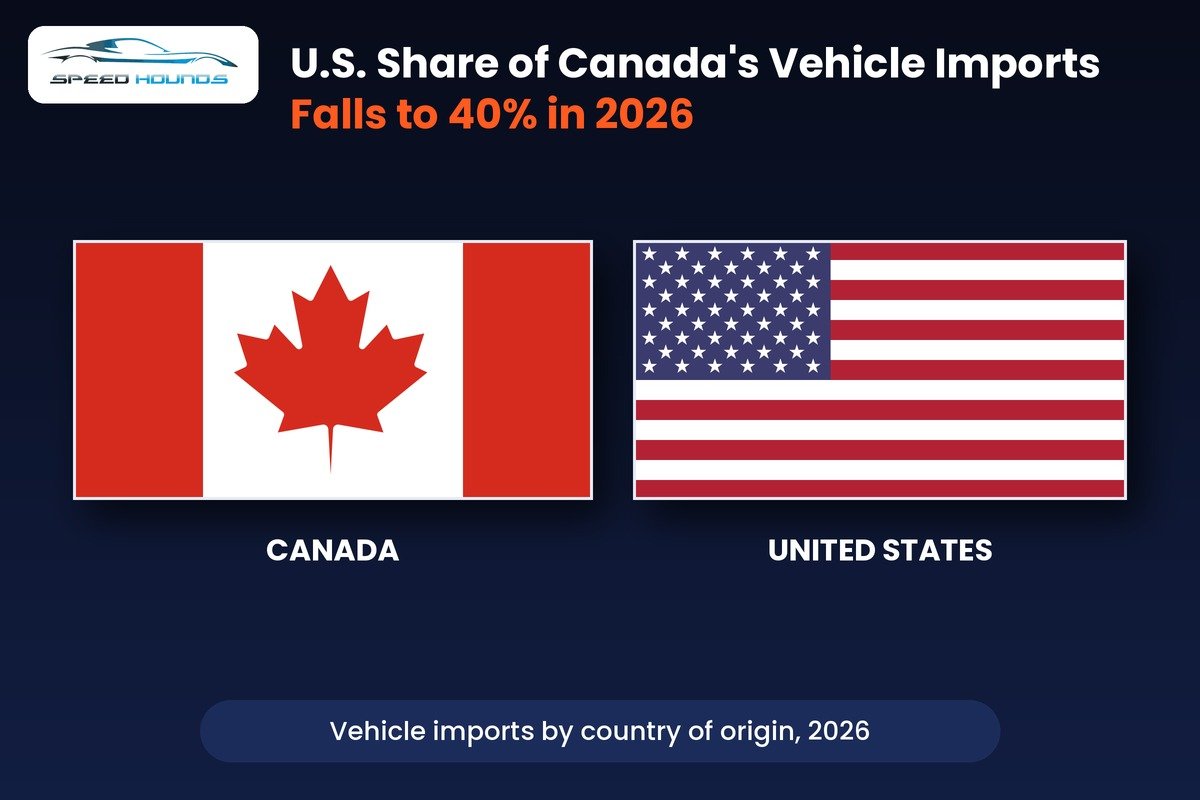
Canada is buying a smaller share of its imported vehicles from the United States, and Mexico, Japan, South Korea and Europe are picking up the difference, according to a DesRosiers Automotive Consultants analysis reported by The Canadian Press on Nov. 25. Measured by dollars, the U.S. accounted for 40 per cent of light-vehicle imports so far in 2026, down from 49.1 per cent in 2024.
Who gained the share
| Origin | 2026 share (year to date) | 2024 share |
|---|---|---|
| United States | 40.0% | 49.1% |
| Mexico | 20.5% | 16.7% |
| Japan | 12.9% | 10.7% |
| South Korea | 12.5% | 10.4% |
| Europe | 11.1% | 9.8% |
| China | 2.6% | 2.9% |
The comparison is with 2024, not last year, and the report does not give the end month for the 2026 figures. China’s share slipped slightly even as Ottawa opened a quota for China-built EVs.
Why sourcing is changing
Andrew King, managing partner at DesRosiers, said what the U.S. lost in share was captured readily by other major exporters, with the trade war helping to diversify Canada’s sourcing. He said certain manufacturers have moved quickly to seek other sourcing where possible. Daniel Ross, senior manager of auto industry insights at Canadian Black Book, said the shift is directly related to trade policy and that manufacturers are fighting to keep prices from climbing. If trade talks do not improve, he said, Mexico and Japan in particular could keep gaining share.
The story sits against Canada’s counter-tariffs on U.S.-made vehicles. Those exclude some of the highest-volume manufacturers, and Canada lets automakers import a quota of U.S.-made vehicles tariff-free, based partly on their Canadian assembly levels. The Canadian Press also notes that U.S. President Donald Trump threatened in August to raise tariffs on Canadian vehicles, parts and steel to 50 per cent on Jan. 1, while Prime Minister Mark Carney says talks are progressing but Ottawa will not accept a deal that leaves no viable auto sector.
What it means for Canadian buyers
Where a vehicle is built can affect its price and availability here, because duties apply to some U.S.-built models. A buyer comparing two similar models may find one sourced from Mexico, Japan or Korea and the other from the United States. Check the build location on the window sticker and ask the dealer about pricing before you commit.
Our earlier coverage shows the same pattern in individual brands, including Honda’s U.S. tariff warning for Canadian buyers, the automakers’ concern that the Chinese EV deal could open a door to gas imports and VW’s $7-billion Ontario battery plant slipping to 2029.