Powertrain primer for Canada: BEV, PHEV, HEV, MHEV and FCEV — what each means for Canadian buyers
Canadians shopping for a new car face more powertrain choices than ever. Electric vehicles are moving from niche to mainstream, hybrids remain widely available, and hydrogen fuel‑cell technology is being trialled in specific regions. This primer explains the basic categories, outlines where each option makes sense in Canada today and highlights the practical checks buyers should do before they buy.
Governments and manufacturers have accelerated investment in zero‑emission vehicle infrastructure and policy in recent years, and Canadian federal programs now focus on supporting charging and alternative‑fuel deployment. At the consumer level, Natural Resources Canada (NRCan) and Transport Canada provide canonical definitions and guidance on powertrain types that Canadian buyers can rely on when comparing options.
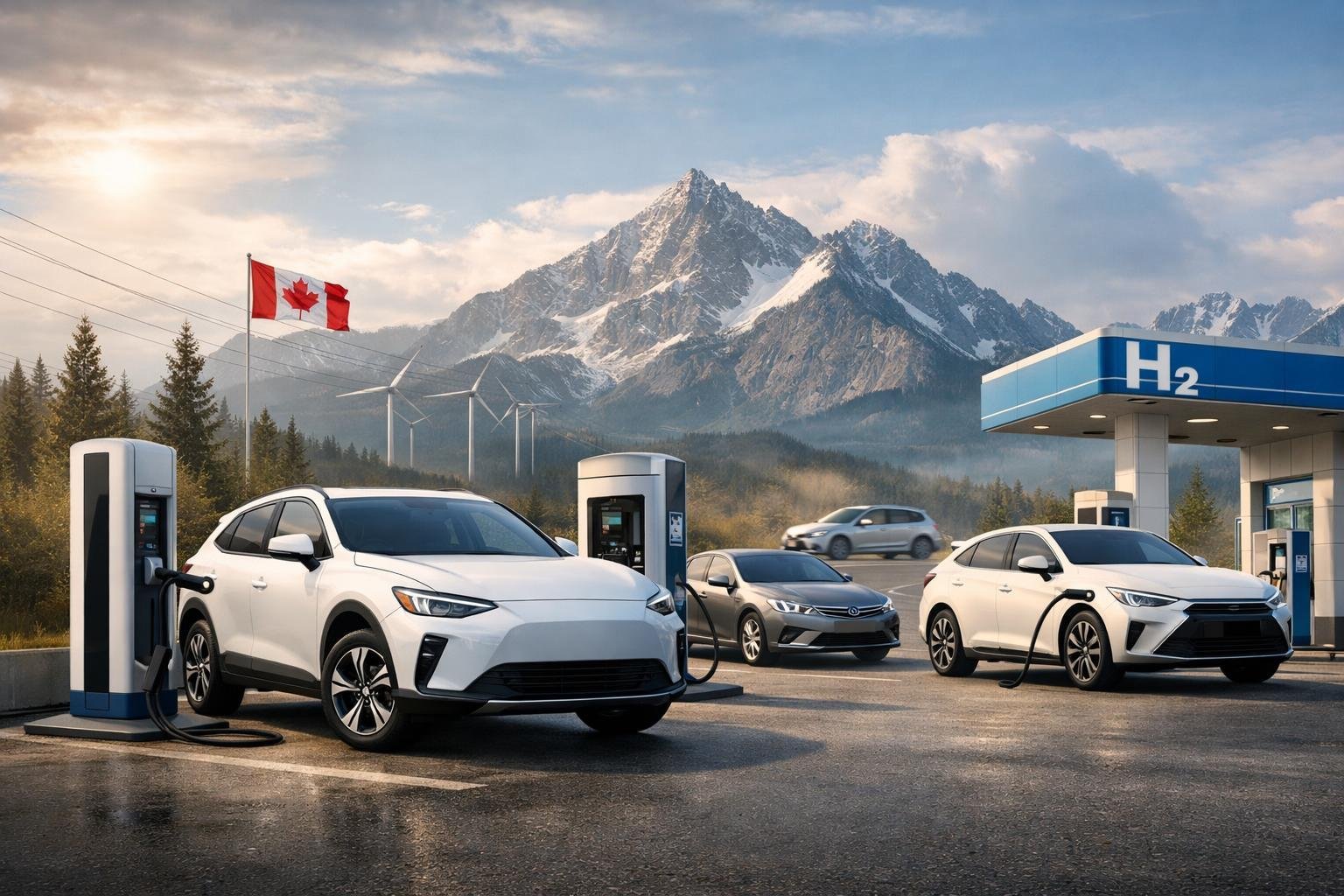
Canada treats battery‑electric vehicles (BEVs), plug‑in hybrids (PHEVs) and hydrogen fuel‑cell electric vehicles (FCEVs) as zero‑emission vehicles (ZEVs) for policy and infrastructure planning. The federal government has funded EV charger and hydrogen station projects through programs such as the Zero Emission Vehicle Infrastructure Program (ZEVIP), and reported targets and public deployments for chargers and a limited number of hydrogen stations. Hydrogen refuelling in Canada today is sparse and geographically concentrated, with British Columbia a primary focal area for public stations.
- BEV (battery‑electric vehicle): Propelled entirely by electric motor(s) and an onboard battery, recharged from the electrical grid.
- PHEV (plug‑in hybrid electric vehicle): Has a rechargeable battery that can be charged from an external source plus an internal‑combustion engine that provides backup range.
- HEV / Full hybrid: Combines an internal‑combustion engine and electric motor(s) but typically is not externally chargeable; the battery is charged by regenerative braking and the engine.
- MHEV (mild hybrid, commonly 48‑volt): Uses low‑voltage electric assist for start/stop, torque assist and modest regenerative capture but generally does not permit electric‑only driving.
- FCEV (hydrogen fuel‑cell electric vehicle): Onboard fuel cell converts compressed hydrogen into electricity to drive electric motor(s); requires hydrogen refuelling stations.
- Charging: BEVs charge using Level 1/2 AC and DC fast (Level 3) chargers; charging times vary with battery size and charger type.
- Policy and incentives: The federal point‑of‑sale consumer incentive program commonly known as iZEV provided rebates for qualifying BEVs, PHEVs and FCEVs but was paused/closed to new funding in 2025. Provincial incentives vary and should be checked at the time of purchase.
What This Means for Canadian Buyers
Each powertrain has a different practical fit depending on where you live, how you drive and what infrastructure is available.
- BEVs: Offer the lowest operating tailpipe emissions and typically lower per‑kilometre energy cost where electricity is low‑carbon. Best for buyers who can rely on home or workplace charging and who do most driving locally. Long‑distance travel depends on corridor charging coverage.
- PHEVs: Work well for drivers with mixed patterns — short daily trips on electric power and occasional long trips using the internal‑combustion engine. Their real benefit depends on whether the owner plugs in regularly.
- HEVs / MHEVs: Provide fuel‑economy improvements without the need for charging infrastructure. Mild hybrids are an incremental, lower‑cost technology if you want better economy without behavioural change.
- FCEVs: Promising where hydrogen refuelling exists because they combine quick refuelling and electric drivetrains. Today, hydrogen refuelling sites are few and concentrated, so FCEV ownership requires local hydrogen access verification.
Practical checklist for Canadian shoppers
- Confirm the specific model and trim are sold in Canada and review the Canadian spec sheet from the manufacturer for range, battery capacity, charging connector and warranty.
- Check public charging and hydrogen refuelling availability in your region using Natural Resources Canada’s station locators and Transport Canada resources.
- Verify current incentive status: federal (iZEV was paused/closed to new funding in 2025) and any provincial programs that may apply.
- Consider typical daily range and access to home or workplace charging before choosing a BEV or PHEV; for FCEVs, confirm nearby hydrogen stations are operational.
Canada’s federal investments in charging and alternative‑fuel infrastructure make BEVs and PHEVs increasingly practical for many buyers, especially in urban and suburban markets with reliable charging. For rural drivers or those without convenient home charging, hybrids and mild hybrids remain a pragmatic choice because they improve fuel efficiency without requiring infrastructure change.
FCEVs retain clear technical advantages — quick refuelling and long effective range — but the current scarcity of public hydrogen stations keeps them a niche option for most Canadians. That can change only if hydrogen refuelling is built out beyond concentrated regional pockets.
Finally, incentives and infrastructure are evolving. The iZEV consumer program’s pause in 2025 is an important affordability factor; provincial programs also vary. For buyers, the most valuable step is to treat powertrain choice as a function of real, local constraints (charging access, commute length, and incentive eligibility) rather than marketing claims.
What is the difference between a BEV and a PHEV?
A BEV is driven solely by electric motor(s) and recharged from the grid. A PHEV has an externally chargeable battery plus an internal‑combustion engine that provides extended range when the battery is depleted.
Are BEVs, PHEVs and FCEVs considered zero‑emission vehicles in Canada?
Yes. Canada treats battery‑electric vehicles, plug‑in hybrids and hydrogen fuel‑cell vehicles as ZEVs for policy and infrastructure planning.
Is hydrogen refuelling widely available in Canada?
No. Public hydrogen refuelling stations are few compared with EV chargers and are geographically concentrated, with British Columbia among the main regions with public stations. Buyers should verify local hydrogen availability before considering an FCEV.
Is the federal iZEV purchase incentive still available?
The iZEV point‑of‑sale consumer incentive program was paused/closed to new funding in 2025. Provincial incentive programs vary; check current federal and provincial program pages when you are ready to buy.
Where can I check charging and refuelling locations and model specifications?
Use Natural Resources Canada’s and Transport Canada’s public station locators for charging and alternative‑fuel sites. For model specs, consult the manufacturer’s Canada website or an official Canadian dealer spec sheet to confirm Canadian range, battery size, charging connector and warranty.