Public EV Charging in Canada: Levels, Networks, Prices and How to Pay
Public charging fills the gap when a home charger is not an option, and the network behind the plug now matters as much as the car. Natural Resources Canada says more than 80% of EV owners charge at home, but road trips, apartment living and long commutes all lean on the public grid. As of March 25, 2026, NRCan data cited by Electric Autonomy counted at least 39,654 public charging ports at 14,743 locations across Canada, up 17.4% in a year.
The three charger levels
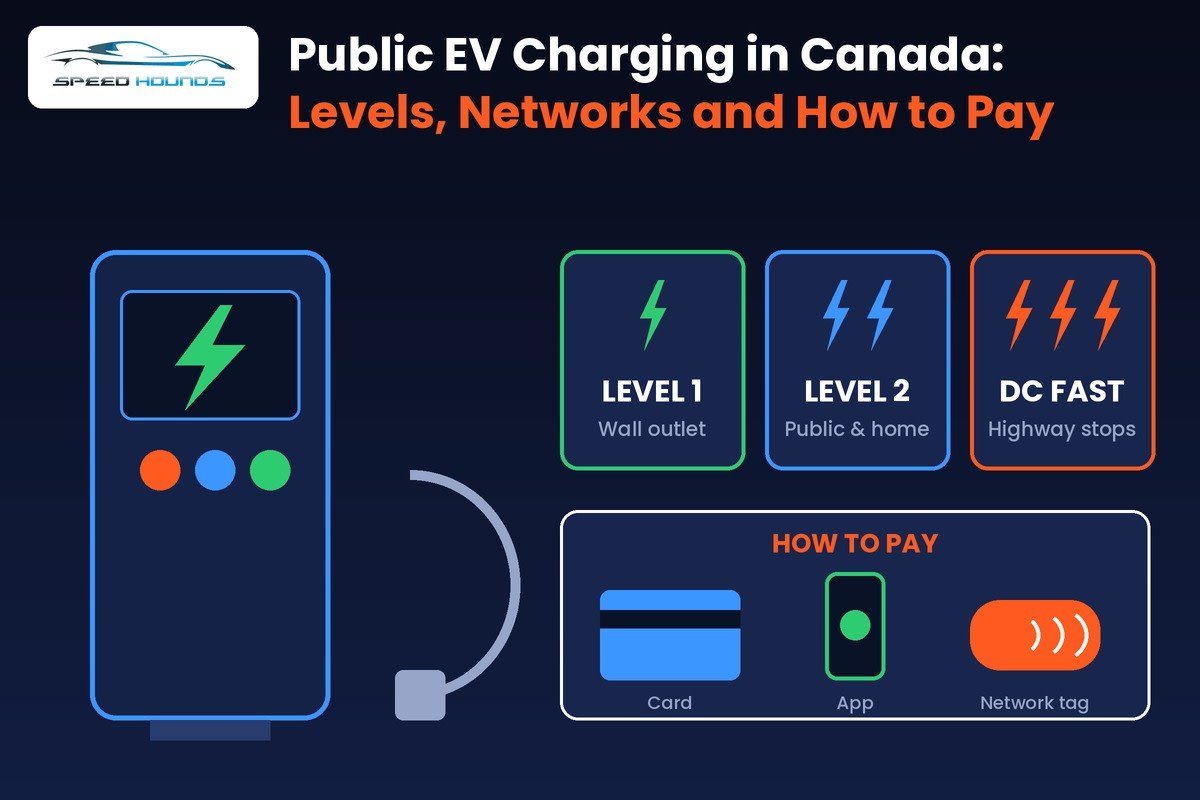
NRCan sorts chargers into three levels. The differences come down to voltage, power and how much range you gain per hour.
| Level | Power source | Range added per hour | Where you find it |
|---|---|---|---|
| Level 1 | Standard 120 V outlet | 3 to 8 km | Mostly at home; cable usually comes with the vehicle |
| Level 2 | 208 or 240 V, the class used by dryers and ovens | 16 to 97 km, depending on the vehicle | Homes, workplaces, malls, parking lots |
| Level 3 (DC fast) | Direct current, high power | Fastest option; NRCan gives no per-hour figure | Highway corridors and public sites |
Level 2 is the workhorse for a few hours at the office or while shopping. DC fast charging is built for the middle of a trip, when you want to add a large share of range in a short stop. The average Canadian drives about 20,000 km a year, or roughly 55 km a day, so most daily needs sit well inside what a Level 2 plug can restore overnight.
How many public chargers are there?
The network is growing faster at the fast-charging end. Electric Autonomy’s 2026 network report, using NRCan numbers as of March 25, 2026, gives this split.
| Type | Ports | Stations | Change over the year |
|---|---|---|---|
| Level 2 | 31,172 | 12,353 | Up 13.5% |
| DC fast | 8,431 | 2,706 | Up about 33.6% |
A year earlier, the same count showed 27,456 Level 2 ports and 6,309 DC fast ports. Some networks are missing from the NRCan list, so the true total is higher.
Who runs the fast chargers
Several large networks cover most DC fast sites, and their power ratings differ. The figures below come from the same Electric Autonomy report.
| Network | Stated power |
|---|---|
| Tesla Supercharger | All above 100 kW; next-generation V4 cabinets planned in Canada in 2026 at over 500 kW |
| FLO | More than 150 stations at 320 to 480 kW |
| Electrify Canada | 150 kW or 350 kW |
| Petro-Canada | 60 to 200 kW |
| Shell Recharge | Up to 180 kW |
| The Electric Circuit | 847 ports at 100 kW or more, including 10 at 350 kW or more |
By NRCan’s count, Tesla runs the most DC fast ports at 2,892, followed by The Electric Circuit at 1,395, FLO at 1,022 and ChargePoint at 594. Tesla says more than 90% of its Superchargers are open to all EVs and that every new site will be.
Connectors: what plugs into what
Connector standards are shifting. Tesla uses NACS, while some other networks, such as Jolt and Co-op Connect, are CCS1 only for now with NACS planned. Networks are adding NACS or supplying adapters, but the picture is uneven.
- Ivy and ONroute sites have NACS connectors or adapters, and 11 sites carry native CCS, NACS and CHAdeMO.
- ChargePoint offers an Omni Port that combines J1772 and NACS on AC units, and CCS1 and NACS on DC units.
- RechargÉco sites all have NACS-to-CCS adapters.
- Circle K sites use CCS and CHAdeMO, and Tesla drivers can use them with an adapter.
- Shell Recharge and Petro-Canada have no NACS connectors, according to the report.
Before a trip, check that the plug type at your planned stops matches your vehicle or that an adapter is allowed on that network.
How public charging is priced
There is no single national pricing method. NRCan says fee-based charging in North America uses one of four models: time-based, a flat fee per use or per month, a charge per kilowatt-hour, or a combination. Time-based and flat-fee billing are the most common in Canada. Some businesses and municipalities offer free charging.
Time billing penalizes cars that charge slowly, since two vehicles pay the same for different amounts of energy. Measurement Canada is developing rules that would allow billing by the kilowatt-hour at public stations, which NRCan compares to buying fuel by the litre.
A January 2026 report from Pollution Probe and the Mobility Futures Lab, covered by Electric Autonomy, found that prices are hard to compare. Energy costs follow provincial electricity rates and sometimes time-of-use rates. Centralized networks such as The Electric Circuit, Tesla and Shell have more uniform pricing, while Level 2 networks hosted at individual sites vary widely. In the survey, 70% of Ontario drivers and 67% of B.C. drivers disagreed that pricing is consistent across locations; the figure was 46% in Quebec and 78% elsewhere. Prices are sometimes visible only inside a network’s own app. NRCan says electricity costs are generally lower than the price of gas, though it gives no dollar figure.
How to pay
Most networks ask you to register for an account before you charge. Drivers typically need different apps or cards for different networks, so setting up two or three accounts before a long trip saves time at the plug.
Some networks are removing that step. Electrify Canada and FLO support Plug & Charge on compatible vehicles, where the car identifies itself to the charger. The Electric Circuit has Autocharge, which works in a similar way, and Petro-Canada has kept tap-to-pay at its stations. Electrify Canada also offers complimentary charging for select models, and FLO has enabled Plug & Charge for GM drivers on its DC fast chargers.
Planning a stop
Check the connector, the stated power and the pricing method before you leave. Fast chargers are not always as fast as their label, because the vehicle itself sets how much power it can accept at any moment, and a station shared between two cars may split its output. Plan around the vehicle’s own limit, not only the number on the charger.
If the app does not show a price, expect to learn it only when the session starts. A home or workplace Level 2 charger covers routine driving, while DC fast stations exist mainly to keep longer trips moving.