Car Loan Length in Canada: How 60, 84 and 96 Months Compare
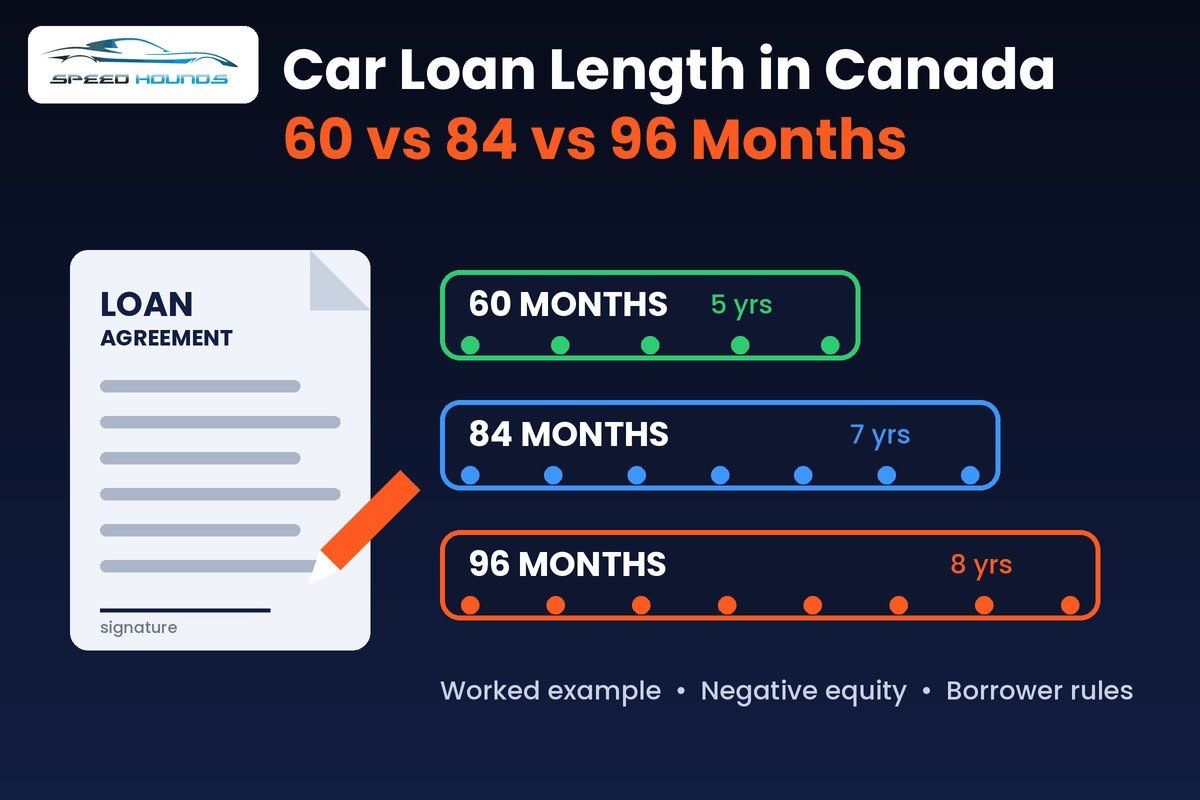
A longer car loan lowers the monthly payment and raises the total you pay, and the gap is larger than most buyers expect. The Financial Consumer Agency of Canada (FCAC) says plainly that the longer the loan term, the lower your payments, and you will end up paying more in interest. This guide puts numbers on that for 60, 84 and 96 months, then covers the rules and protections Canadian borrowers actually have.
Last updated November 2026
Why loan length matters more than the rate
Dealers and lenders often quote a monthly payment first. FCAC advises looking at the total cost rather than just the payment or the interest rate, and comparing offers on the interest rate, payment schedule, financing fees, total amount financed and length of the loan. A low payment can simply mean a long loan.
FCAC defines a long-term loan as a term of 72 months (six years) or more. Terms of 84 months and longer are common enough that FCAC’s own example uses one. Our look at how Canadians afford $80,000 pickups shows how seven-year loans are being used to keep payments manageable.
The same loan at 60, 84 and 96 months
FCAC’s own example is a $25,000 car at 5 per cent. It shows a 36-month term costing $26,974 in total and an 84-month term costing $29,681, which is $2,707 more and more than twice as much in interest. We extended the same calculation to 60 and 96 months using the standard monthly-payment formula. The 36 and 84-month results match FCAC’s figures to the dollar.
| Loan term | Monthly payment | Total interest | Total cost |
|---|---|---|---|
| 36 months (FCAC example) | $749.27 | $1,974 | $26,974 |
| 60 months | $471.78 | $3,307 | $28,307 |
| 84 months (FCAC example) | $353.35 | $4,681 | $29,681 |
| 96 months | $316.50 | $5,384 | $30,384 |
Assumptions: $25,000 borrowed at a fixed 5 per cent, monthly payments, no fees, no down payment, taxes excluded. The 60 and 96-month rows are Speedhounds calculations; the 36 and 84-month rows match FCAC’s published table.
Moving from 60 to 96 months cuts the payment by about $155 a month. It also adds $2,077 in interest. A real offer may carry a different rate at each term, so run your own quote through the same maths.
Negative equity: the other cost of a long loan
A new car loses value quickly. FCAC says a new vehicle may be worth 25 per cent less after one year, then typically loses 15 to 25 per cent of its value each year over the next four. When the loan balance falls more slowly than the car’s value, you owe more than the car is worth. That is negative equity.
FCAC illustrates it with a $31,300 car, $3,700 in taxes and fees, and a $35,000 loan at 4 per cent over eight years, a payment of about $425 a month. After one year the car is worth $23,475 against a $31,200 balance, a $7,725 gap. After two years the car is worth $18,780 against $27,300 owing, a gap of $8,520. The example is illustrative, not a quote.
The gap matters in three situations FCAC names: a quick sale, where you may have to borrow to cover the difference; a total-loss accident, where insurance may not cover what you owe; and a trade-in, where the shortfall rolls into the next loan and increases the interest on it. For how fast different vehicles lose value, see our guide to which vehicles hold their value in Canada.
Where to get the loan
FCAC lists two routes. You can arrange financing at the dealership, which may use the manufacturer’s finance arm, a bank or credit union, or an independent finance company. Or you can borrow directly from your own financial institution. FCAC notes you may be able to negotiate a better rate if you have a bank account, mortgage and credit card in good standing.
The agency also says a dealer does not have to offer you the lowest interest rate. It recommends collecting several offers, since a lender or another dealership may beat the first quote, and it points out that dealer administration fees may also be negotiable.
Rules and protections for Canadian borrowers
- Disclosure statement: the lender or dealer must give you a statement showing the total cost of borrowing before the agreement is final. Ask for a copy.
- No cooling-off period in most places: FCAC says that in most provinces and territories there is no cooling-off period on car loans and lease agreements, so a signed contract is hard to undo. Your provincial or territorial consumer affairs office can confirm local rules.
- Which law applies: loans from federally regulated banks fall under federal consumer protection law. Other lenders fall under provincial or territorial law, which may not cover some independent car-finance companies.
- One dealership at a time: FCAC warns against signing a contract with more than one dealership, and says a dealer may keep some or all of a deposit if you walk away.
- Sign in order: dealers must give an approval and quote on a signed application. FCAC advises not signing a vehicle sales agreement until you have made your final decision.
How to choose a term
FCAC’s guidance is to buy a car that fits your budget, choose the shortest term you can afford, and put down a deposit if possible. It also suggests avoiding a trade-in while you are in negative equity. In practice that means checking the payment at 60 months first. If that payment does not fit, the car may be priced above your budget, and stretching to 84 or 96 months hides that rather than solving it.
Before you sign, compare at least one dealer quote with one from your own bank, and ask for the total cost of borrowing on each. Our breakdown of what a $40,000 car really costs over five years shows how financing sits alongside insurance, fuel and maintenance.
The federal government also publishes a Vehicle Lease or Loan Calculator, which FCAC links from its car-financing pages. Running your own price, rate and term through it before you visit a dealer gives you a number to measure their offer against, and costs nothing.