Excessive Speeding in Canada: Fines, Impounds, Suspensions
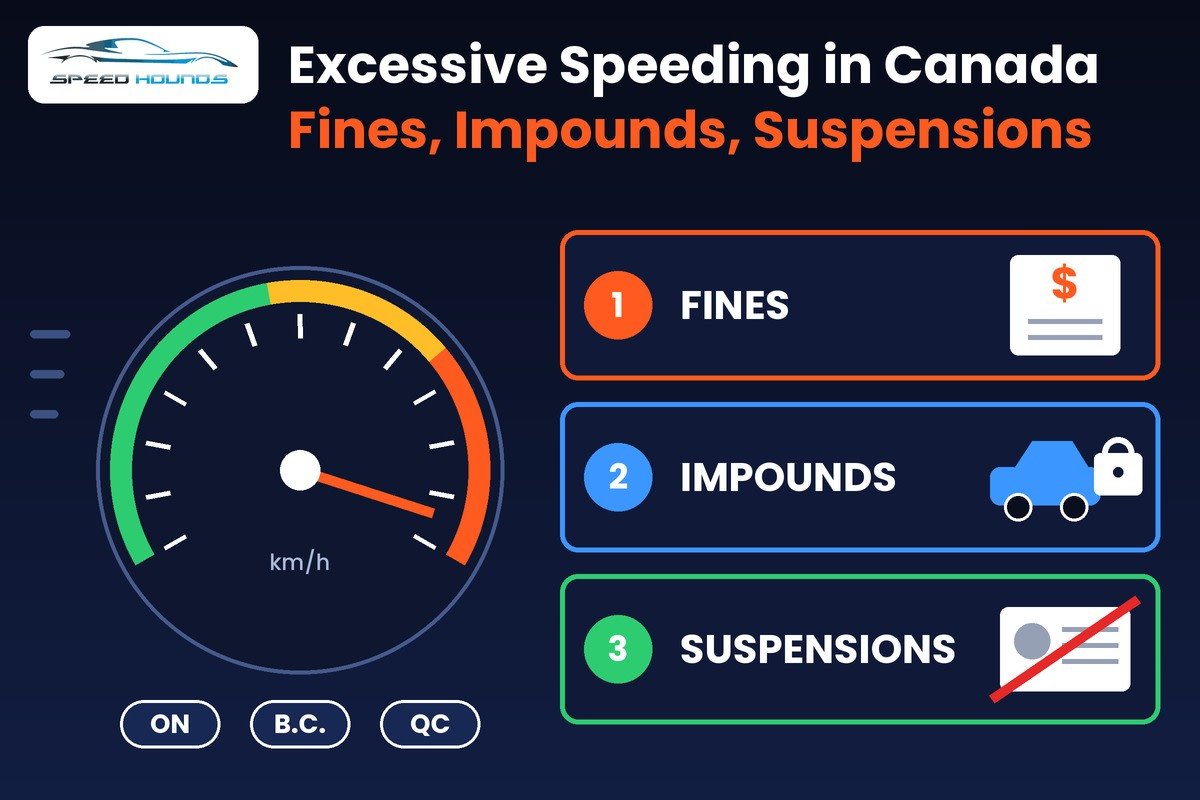
A speeding ticket in Canada is a modest fine. Excessive speeding is a different category, with roadside licence suspensions, vehicle impoundment and, in Ontario, a criminal-style stunt driving charge. The rules are set by each province, and the thresholds that trigger them are lower than many drivers expect. This guide compares the official rules in Ontario, British Columbia and Quebec, based on the Ontario government’s speeding and aggressive driving page and the equivalent B.C. and SAAQ pages. Other provinces and territories have their own limits and penalties, so check your provincial transportation ministry for the current figures.
Ontario: stunt driving starts at 40 or 50 km/h over
Ontario treats extreme speed as stunt driving. You can be charged for driving 40 km/h or more over the limit on roads posted below 80 km/h, 50 km/h or more over the limit on any road, or 150 km/h or more anywhere in the province, including freeway sections posted at 110 km/h.
The penalties are heavy. A stunt driving or street racing conviction carries a fine of $2,000 to $10,000, six demerit points and up to six months in jail. Police impose an immediate 30-day licence suspension and a 14-day roadside impoundment of the vehicle, and that applies whether or not you own the vehicle. A conviction brings a further licence suspension: one to three years for a first conviction, three to 10 years for a second, and a lifetime suspension for a third, which can be reduced after 10 years under certain criteria. A fourth conviction brings a lifetime suspension that cannot be reduced. Convicted drivers must also complete a driver improvement course.
Below the stunt threshold, ordinary speeding fines are set per kilometre an hour over the limit, as listed on the Ontario page (figures as of June 2020).
| Speed over the limit | Fine per km/h over | Demerit points |
|---|---|---|
| Under 20 km/h | $3.00 | 3 points from 16 km/h over |
| 20 to 29 km/h | $4.50 | 3 |
| 30 to 49 km/h | $7.00 | 4 |
| 50 km/h or more | $9.75 | 6 |
As the Ontario page works out, 40 km/h over the limit is a fine of $7 x 40 = $280, before any court costs or surcharges. The larger cost is usually indirect, because a conviction can raise your insurance premium for years.
British Columbia: excessive speed means more than 40 km/h over
B.C. defines excessive speeding as driving more than 40 km/h over the posted limit. The B.C. government lists a $368 fine and three penalty points for more than 40 km/h over, and a $483 fine and three points for more than 60 km/h over. On top of the fine, police impound the vehicle: seven days for a first offence, 30 days for a second offence within two years, and 60 days for any later offence in that period. The driver pays all towing and storage costs, and the registered owner also has to pay them even if someone else was driving.
Quebec: suspensions come first, and fines double
Quebec sets its threshold by speed zone. According to the SAAQ, excessive speeding means 40 km/h or more over the limit in zones of 60 km/h or less, 50 km/h or more in zones above 60 km/h and up to 90 km/h, and 60 km/h or more in zones of 100 km/h or higher.
Within a 10-year period, the immediate penalty rises with each offence, and the fines and demerit points are increased once you are found guilty.
| Offence | Immediate penalty | If found guilty |
|---|---|---|
| First | 7-day licence suspension | Demerit points doubled; fine doubled |
| Second | 30-day suspension; 30-day vehicle impoundment if both offences were in zones of 60 km/h or less | Demerit points doubled; fine doubled |
| Third | 30-day suspension, or 60 days if all three offences were in zones of 60 km/h or less | Demerit points doubled; fine doubled |
| Fourth and later | 30-day suspension, or 60 days under the same rule; 30-day impoundment in some cases | Demerit points doubled; fine tripled |
A conviction stays on your driving record for 10 years, and the cost of your licence rises with your accumulated demerit points. The SAAQ publishes the dollar amounts of fines and the point values in a separate schedule.
How the three provinces compare
| Ontario | British Columbia | Quebec | |
|---|---|---|---|
| Trigger | 40 km/h over under 80 km/h zones; 50 km/h over elsewhere | More than 40 km/h over | 40, 50 or 60 km/h over, depending on zone |
| Roadside action | 30-day licence suspension; 14-day impound | 7-day impound for a first offence | 7-day licence suspension for a first offence |
| Fine | $2,000 to $10,000 (stunt driving) | $368 or $483, depending on speed | Doubled on a guilty finding |
| Jail possible | Up to 6 months | Not listed on the B.C. page | Not listed on the SAAQ page |
What it means for the vehicle owner
The impoundment rules reach beyond the driver. In both Ontario and B.C., the vehicle can be impounded whether or not the driver owns it, and in B.C. the registered owner is on the hook for towing and storage charges. If you lend your car to a young family member or a friend, you carry some of the risk.
Insurance is the other long-term cost. A speeding or stunt driving conviction can change what you pay at renewal. Our look at what a $40,000 car really costs over five years in Canada shows how insurance sits alongside fuel and depreciation in the ownership bill.
Practical points for Canadian drivers
Highway limits differ by province, and construction and school zones often carry reduced limits with higher penalties, so watch the signs when you cross a provincial border. Winter driving lowers the margin for error, and the thresholds above are measured against the posted limit, not against road conditions. For the winter side of the rules, see our province-by-province guide to winter tire rules, and if you travel with children, our guide to child car seat laws by province and territory covers another set of rules that change at the provincial border.