Honda’s $867-Million Alliston Commitment Puts Canadian Hybrid Production in Focus
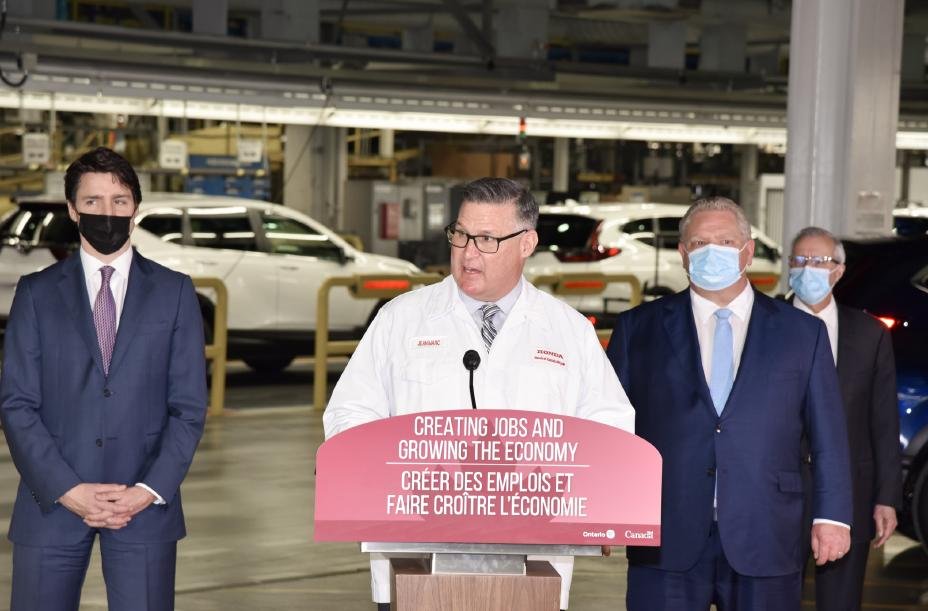
Honda’s new Alliston commitment is significant for what it says about Canadian manufacturing: the company intends to keep building gasoline vehicles while expanding its ability to produce hybrids, engines and related systems. Its November 9 announcement identifies $166 million in capital spending on upgrades and retooling, within a broader $867-million commitment that includes future planned investments and related expenses. Those figures are not interchangeable.
Honda says the project is designed to maintain more than 4,000 jobs at its two Ontario plants. It also forms part of a wider North American production strategy that includes operations in Ohio, Alabama and Georgia. That matters because hybrid vehicle assembly, engine production and component supply need to develop together.
Understanding the investment
The specific $166-million capital project covers upgrades and retooling for next-generation gasoline and hybrid-electric vehicles, including the reintroduction of engine manufacturing in Alliston. Honda says the broader $867-million figure includes future planned investments and related expenses, but does not provide a model-by-model breakdown or completion timeline.
Federal support is described as $313 million, while Ontario is contributing $156 million. These are government contributions associated with the initiative, not extra spending that Honda says it will make itself. Nor should the figures be added together and presented as one confirmed plant-construction budget without more detailed financing information.
Honda’s stated objective is manufacturing flexibility: the ability to adjust its output and powertrain mix as demand evolves. That is more informative than treating the announcement as a single new model launch.
Why Honda is investing in hybrids
Alliston already makes electrified vehicles. Line 1 produces gasoline and hybrid versions of the Civic sedan, and Line 2 builds gasoline and hybrid CR-V models. Honda is preparing those operations for future products rather than replacing all gasoline production with battery-electric vehicles.
Hybrids offer electric assistance without the same dependence on external charging as a battery-electric vehicle. For Canadians who drive long distances or lack convenient charging at home, that can be a practical proposition. Fuel consumption, however, depends on the actual model and driving conditions; Honda has not provided new consumption ratings in this release.
In May 2026, Honda announced plans for 15 new Honda and Acura hybrid models globally by 2030, with North America a major target market. The Alliston investment supports that broader plan, but the company has not confirmed which future vehicles will be allocated to Ontario.
The significance of engine manufacturing
One of the most important details is Honda’s plan to bring engine manufacturing back to Alliston. It suggests the operation is being equipped for more than final vehicle assembly. Engine production requires specialized processes, skills and suppliers, potentially deepening the plant’s role within Honda’s North American network.
The announcement does not identify an engine family, annual engine output or a start date. It would be inaccurate to claim that every future Canadian-built Civic or CR-V will receive an Alliston-made engine. The confirmed point is the planned return of that manufacturing capability.
Forty years of Canadian production
Honda began producing the Accord in Alliston in November 1986, becoming the first Japanese automaker to establish vehicle manufacturing in Canada. Its second plant opened in 1998 to make the Odyssey, and Alliston became the first plant outside Japan to manufacture Acura vehicles.
The facilities now occupy approximately four million square feet, with annual capacity exceeding 400,000 vehicles. Honda reports that 401,000 vehicles were built there in 2025, when it also produced its 11-millionth Canadian vehicle. Honda describes Alliston as the country’s second-largest vehicle manufacturing operation by volume that year.
Honda also says it sources more than $3 billion in goods and services from Canadian suppliers each year. That supply chain makes the investment relevant to companies well beyond the immediate factory workforce, although the announcement does not quantify any new supplier positions.
Jobs and public funding
Honda explicitly says the investment will maintain its workforce of more than 4,000 people. Maintaining existing employment is not the same as announcing 4,000 newly created jobs, and the release does not promise that every staffing level will remain unchanged indefinitely.
Ontario links its contribution to industrial competitiveness amid U.S. tariff uncertainty. The federal government emphasizes the domestic supply chain and the transition toward future vehicle technologies. In both cases, public support is being justified as an investment in long-term Canadian production capacity.
What Canadian drivers should watch
There are no new model specifications, Canadian MSRPs or dealership dates in this announcement. The next meaningful milestones will be confirmation of the models assigned to upgraded lines, the timing of engine manufacturing and verified efficiency figures for any new hybrids.
For buyers, the practical story is continuity: Honda wants Alliston to remain central to the vehicles Canadians purchase while its powertrains evolve. That is important industrial news, but it should not be confused with a confirmed new Civic or CR-V launch.