Tire Pressure in Canada: How to Check It and What Winter Does
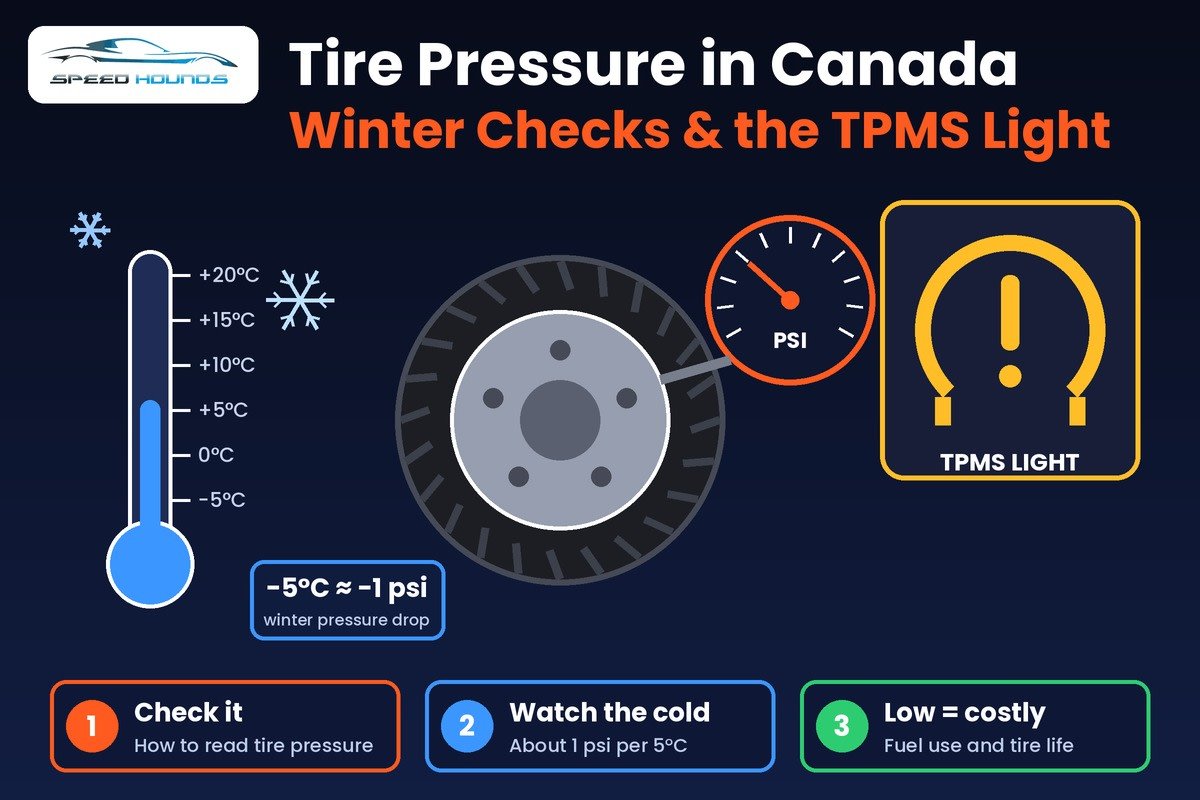
Cold weather lowers tire pressure, and that is the reason many Canadians see the dashboard warning light on the first frosty morning. Transport Canada’s guidance is that tire pressure should be checked at least once a month, on every tire including the spare, and that a tire pressure monitoring system (TPMS) does not replace that habit. This guide covers how to check pressure correctly, what winter does to it, and what the warning light means.
Last updated November 2026
How to check your tire pressure
Transport Canada says to measure pressure when the tires are cold. It defines cold as a vehicle that has been stationary for at least three hours, or has not been driven more than 2 km. A reading taken after a long drive will not reflect the true cold pressure.
Use the pressure on the vehicle’s tire information label, not the number on the tire. Transport Canada says the label is usually attached to the edge of the driver’s door, the door post, the glove box or the fuel door. If you cannot find it, check the owner’s manual. Natural Resources Canada gives the same advice: the placard is usually on the edge of the driver’s door or the doorpost. The figure moulded into the sidewall is the tire’s maximum pressure, not necessarily the one your vehicle needs.
A pocket gauge is the better tool. Transport Canada notes that pocket gauges are generally more accurate than the gauges on gas station air pumps. Check all four tires and the spare, write the readings down once, and top up to the placard pressure in kilopascals (kPa) or pounds per square inch (psi), whichever your gauge shows.
Why winter drops tire pressure
Transport Canada puts the drop at about 7 kPa, or 1 psi, for every 5°C fall in temperature. Tires also lose some air naturally over time, which the same publication estimates at about 14 kPa, or 2 psi, a month.
The temperature rule adds up quickly across a Canadian autumn. We applied Transport Canada’s figure to some typical swings:
| Temperature drop | Approximate pressure loss |
|---|---|
| 5°C | 7 kPa (1 psi) |
| 15°C | 21 kPa (3 psi) |
| 25°C (for example +10°C to -15°C) | 35 kPa (5 psi) |
| 35°C (for example +10°C to -25°C) | 49 kPa (7 psi) |
The figures above are Speedhounds calculations from Transport Canada’s 7 kPa per 5°C rule, rounded, and do not include the monthly natural loss. They show why a tire that looked fine in October can be well below spec in January.
What underinflation costs you
Both federal sources link low pressure to fuel use and tire life. Natural Resources Canada says driving with tires underinflated by 56 kPa (8 psi) can increase fuel consumption by up to 4 per cent and can shorten tire life by more than 10,000 km. Transport Canada’s tire guide gives a similar example, describing a single tire underinflated by 56 kPa (8 psi) as able to reduce tire life by 15,000 km and increase fuel consumption by 4 per cent. The two sources state the tire-life figure differently, so treat it as a range rather than an exact number.
Transport Canada also warns that a tire can lose as much as 20 per cent of its pressure without the driver noticing. For a look at how fuel ratings work more generally, our guide to the EnerGuide label and fuel ratings explains how to read the numbers you are comparing against.
What the TPMS light means
Many newer vehicles have a TPMS that warns the driver about low pressure. Transport Canada’s TPMS page says some systems only warn when a tire is significantly underinflated, so a tire can be low without the light being on. When the warning does come on, the guidance is to measure your tire pressure as soon as possible.
Transport Canada also says large outdoor temperature changes can trigger the low-pressure warning. That matches the winter pattern: the light often appears on the first cold morning. If it comes on, check the pressure with a gauge rather than assuming the cold caused it.
A different warning can appear if tires have been changed or rotated and the system has not been reset. Transport Canada says some systems allow the driver to reset them. Check your owner’s manual for the procedure on your vehicle. The pages we reviewed do not describe the difference between a steady and a flashing light, so the manual is also the place to confirm what each pattern means in your car.
A five-minute winter checklist
- Check pressure once a month, and again after a large temperature drop.
- Measure when the tires are cold: parked for three hours or driven no more than 2 km.
- Use the pressure on the door placard or in the owner’s manual, never the sidewall maximum.
- Check all four tires and the spare with a pocket gauge.
- If your vehicle has a TPMS, treat the light as a prompt to check, not as a substitute for checking.
Pressure and winter tires
Switching to winter tires is a natural moment to check pressure, because the new set starts from whatever it was filled to at the shop. Our guides to winter tire rules in Canada and to AWD versus winter tires cover which provinces require them and what the federal agencies say about traction. Correct pressure matters on either set, and it costs nothing to verify.