Selling a Car Privately in Canada: Ontario, B.C., Alberta Rules
Selling a car privately in Canada means doing the paperwork a dealer would otherwise handle, and the steps depend on the province. In Ontario, the seller must buy a Used Vehicle Information Package before the sale, as set out on the Government of Ontario’s buy or sell a used vehicle page. British Columbia and Alberta use their own forms and have their own rules on plates, payment and insurance.
Last updated November 2026
This guide covers the three provinces where the official requirements are clearest. Check your provincial registry or insurer before you list, because forms and fees change.
Before you list the vehicle
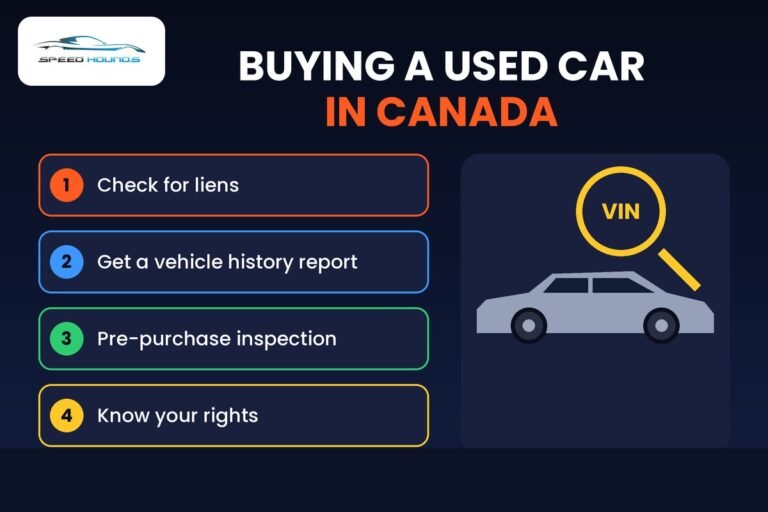
Start with the basics a buyer will ask about: the vehicle identification number (VIN), the registration, any money still owed on it and the service history. In Ontario the VIN on your ownership permit (the green document) has to match the vehicle. A lien is a claim by a lender against the vehicle, and it can follow the car to the next owner, so settle it before the sale or arrange the payout with your lender as part of the deal.
It also helps to check for open safety recalls and be ready to tell buyers what you find. Our step-by-step guide to checking a vehicle recall in Canada shows how to search by VIN.
Pricing it fairly
Compare similar listings in your area, then adjust for kilometres, condition and trim. Wholesale prices also move: our report on falling Canadian used-car wholesale values explains what a drop in wholesale values does and does not say about retail asking prices. Write the agreed price on the bill of sale in every province, since it is the record of the deal.
Ontario: what the seller must hand over
Ontario requires the seller of a car, van, light truck, motorcycle or similar vehicle with an empty weight of 2,200 kg or less to provide a Used Vehicle Information Package (UVIP). It is not required for family transfers or purchases from registered dealers. The package lists the registration history, previous owners and odometer readings, lien information, the average wholesale value used for tax, and whether the vehicle was last reported as wrecked.
You order it online with the VIN or plate number and pay by Visa or Mastercard. The ministry says it is sent within five business days of an online purchase and delivery can take up to 10 days, so order it before you list the car rather than after you find a buyer.
| Item | What Ontario requires |
|---|---|
| UVIP | Provided by the seller to the buyer |
| Bill of sale | Original, signed; names, buyer’s address, date, price, VIN, make, year, power source, body type and colour |
| Application for Transfer | On the back of the ownership permit; seller completes and signs |
| Safety Standards Certificate | From a licensed mechanic, if required for the transfer |
| Licence plates | Stay with the seller, who keeps the plate portion of the permit |
The seller does not collect sales tax. The buyer pays 13% retail sales tax when registering, calculated on the higher of the purchase price or the wholesale value in the UVIP. Vehicles 20 years old or older need an appraisal. Light passenger vehicles no longer need an emissions test to transfer ownership; the requirement now applies only to used heavy diesel commercial vehicles over 4,500 kg.
If the UVIP shows a lien, contact the Personal Property Security Branch of the Ministry of Government and Consumer Services. The province also advises sellers to take their plates off and return them to a ServiceOntario centre or store them safely, then check periodically that nobody has altered or swapped them.
British Columbia: the transfer form and the plates
ICBC’s process for private sellers turns on two documents: your original signed registration (the APV250, with its insurance and registration portions) and the Transfer/Tax Form (APV9T). All four pages of the APV9T must carry original signatures from both seller and buyer.
- Accept only cash or a bank draft, and confirm any bank draft with the issuing institution before you hand over the vehicle.
- Remove your plates and the insurance portion of your registration, and give the signed registration portion to the buyer.
- Take the registration and APV9T to an Autoplan broker. ICBC strongly recommends going together; if you cannot, keep copies bearing both signatures.
- Cancel your insurance or transfer it to another vehicle. If you transfer it, you will need to provide the odometer readings of both vehicles.
Plates in B.C. remain ICBC’s property, so they cannot be sold with the car; return them to ICBC or a broker if you no longer need them. A safety inspection is not required for the sale, though a buyer can ask for a pre-purchase inspection. The buyer must register the vehicle within 10 days. If the car is unlicensed and uninsured, a broker can issue a Temporary Operation Permit so that buyers can test drive it.
Alberta: the standard bill of sale
Alberta’s government publishes a Standard Bill of Sale (form REG3126) for private sales, and its page says the form must be used to transfer ownership of the vehicle. It records the full name and address of each buyer and seller, the VIN, the make, model, style, colour and year, the cost of the vehicle, and the signatures of both parties.
The form also leaves room for optional details that protect both sides: the odometer reading, any liens, whether the vehicle is paid in full, the payment method and terms, and any special conditions. Filling those in is worth the extra minute. Dealers and other automotive businesses have to use a comprehensive bill of sale instead.
Safer ways to hand over the car
- Meet at a bank or in a public place and complete the payment there, particularly for a bank draft that needs verifying.
- Keep copies of every signed document, plus the listing and any messages that describe the vehicle’s condition.
- Describe known problems in writing. If you are selling an electric or hybrid, buyers will ask about the battery and warranty, and our guide to buying a used EV in Canada lists the checks they are likely to make.
- Deal with your insurance and plates as your province requires before the buyer drives away.
Where the rules differ outside these provinces
Quebec, the Atlantic provinces, Manitoba and Saskatchewan each have their own registry forms, fees and insurance rules. Start with your provincial motor vehicle agency or public insurer for the current forms and fees before you sign anything.