What to Do After a Car Accident in Canada: When You Must Report
A collision in Canada triggers two separate sets of rules: what police require and what your insurer expects. In Ontario, the Highway Traffic Act requires a report “as soon as possible” when anyone is injured or when combined damage to vehicles or property is over $5,000, according to Toronto Police Service. Quebec runs a different system built around the province’s public auto insurance plan. This guide covers the steps that apply almost everywhere, then the rules we could confirm from official pages in Ontario and Quebec.
Last updated November 2026
First steps at the scene
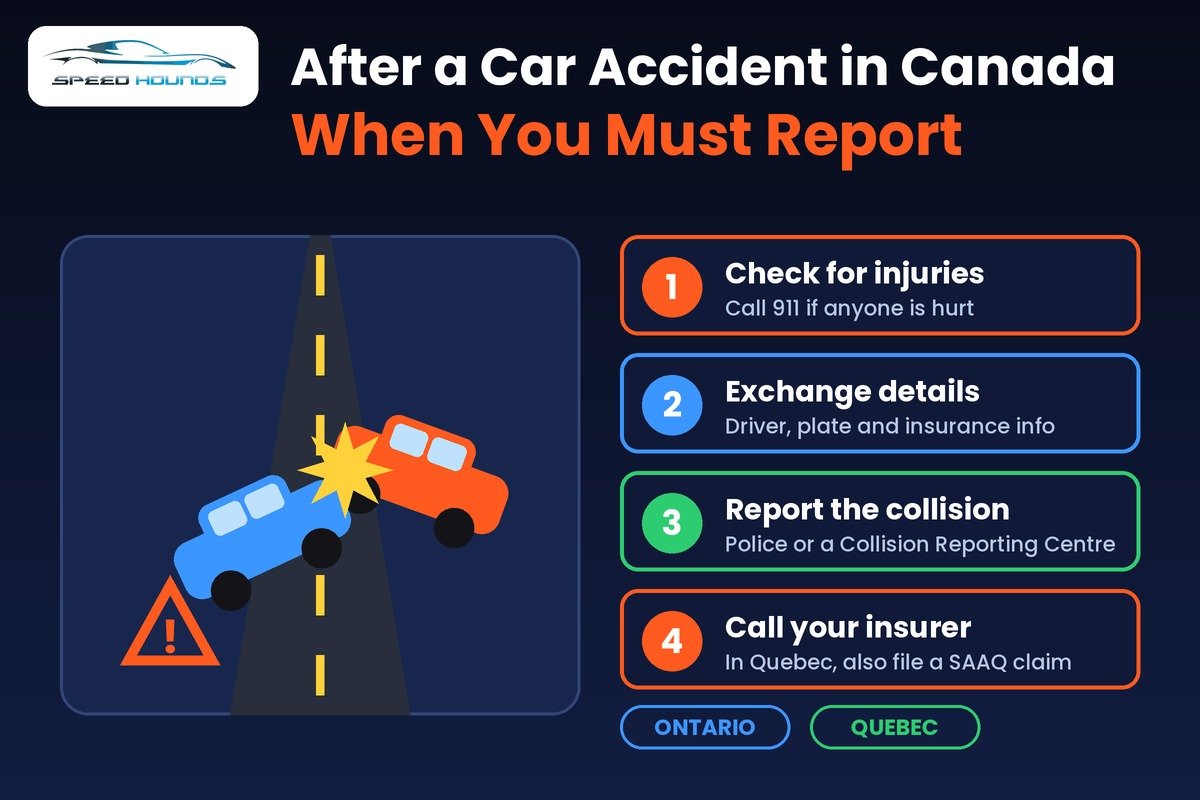
Call 9-1-1 if anyone is hurt or if there is evidence of a crime such as impaired driving. Toronto and Ottawa police both list the same order of steps: stay calm, move vehicles out of traffic if it is safe to do so, and check the damage before deciding who to call.
Exchange information with the other driver before anyone leaves. Police in both cities ask you to record the location, the other vehicle’s plate, year, make, model and colour, the driver’s licence details, the insurance company and policy number, and the other driver’s full name, address and phone number. Photograph the other driver’s documents, the vehicles, the damage and the scene. If there are witnesses, take their names and phone numbers.
The Insurance Bureau of Canada adds a few details worth writing down: the date, time and location, how the collision happened, the speed, the weather and road conditions, and the officer’s name and badge number if police attended.
When police must attend
Toronto Police and the Ottawa Police Service list the same situations in which officers attend the scene:
- A fatality or an injury serious enough to need hospital transport
- Criminal activity, such as impaired driving, a stolen vehicle or an assault
- An uninsured or suspended driver
- Damage to private, municipal or highway property
- An injured cyclist or pedestrian
- A collision between midnight and 8:00 a.m. where a vehicle cannot be driven
On 400-series highways such as the 401 or 427, Toronto Police direct drivers to the Ontario Provincial Police. Outside Toronto, you contact the police service for that area.
Ontario: collision reporting centres
If police do not attend and the collision meets the reporting threshold, you go to a Collision Reporting Centre (CRC). Both Toronto and Ottawa say the threshold is injuries or combined damage valued at more than $5,000. For very minor damage below that level, Toronto Police advise contacting your insurer.
| City | Reporting centres | Notes |
|---|---|---|
| Toronto | East CRC, 39 Howden Rd., Scarborough (416-808-4960); North CRC, 113 Toryork Dr., North York (416-808-3960) | Open 8 a.m. to midnight, seven days a week |
| Ottawa | 211 Huntmar Rd., Kanata; 474 Elgin St., Ottawa; 3343 St-Joseph Blvd., Orleans | Operated by Accident Support Services International; non-emergency line 613-236-1222 |
Bring your driver’s licence, proof of vehicle ownership and proof of insurance. Both police services let you start the report online before you arrive. Ottawa Police state that collisions must be reported within 30 days; Toronto’s page says only “as soon as possible,” so treat the same-day rule as the safe approach.
Towing costs and your choices
Toronto Police say a vehicle towed from the scene must go directly to a CRC. The flat towing fee is $310.44 plus tax under the city’s municipal code, and the CRC pays it rather than the driver. You are free to choose your own tow truck and body shop. Ottawa Police advise calling the 1-800 number on your insurance documents and not accepting a tow operator’s claim that it holds a police contract.
Quebec: a different system
Quebec drivers are covered for bodily injury by the province’s public plan, run by the SAAQ, regardless of who was at fault and wherever the accident happens in the world. If you are injured, the SAAQ says to see a physician as soon as possible, ask for the initial medical report, phone the SAAQ at 1-800-361-7620 to open a claim file, and call your private insurer about damage to the vehicle. A claim must be filed within three years of the accident. The SAAQ page we reviewed does not set out when police must be called or how the joint accident report works, so confirm those points with your insurer.
Notify your insurer promptly
The Insurance Bureau of Canada says to report a collision to your insurer promptly, within 48 to 72 hours. Do not authorize repairs beyond what is needed to prevent further damage until the insurer has inspected the vehicle or given consent. Keep every document, including the police report number, photos, towing bills and any joint report, for the provincial limitation period. If you have questions, the IBC Consumer Information Centre is at 1-844-227-5422. Our guide to vehicle safety inspections by province explains what can be required before a repaired vehicle returns to the road in some provinces.
What to collect before you leave the scene
Insurers and police ask for the same core details, so one checklist covers both. Collect these items while you are still at the scene, because they are hard to reconstruct later.
| Item | What to record |
|---|---|
| Other driver | Full name, address, phone number, licence details |
| Other vehicle | Plate, year, make, model, colour, insurance company and policy |
| Scene | Date, time, location, weather and road conditions, photos from several angles |
| People | Names and numbers for witnesses and anyone injured |
| Police | Officer’s name, badge number and the report number if police attended |
Photos of the other driver’s licence, plate and insurance slip are faster and more accurate than writing everything down, which is what the Toronto and Ottawa police pages recommend.
After the report: repairs and claims
Once the report is filed and your insurer is notified, the insurer will tell you how to proceed with the claim. Keep any repair estimates and receipts. The IBC advises not authorizing repairs, other than those needed to prevent further damage, until the insurer has inspected the vehicle or agreed to the work. That includes towing and storage: ask who is paying before you sign anything, and ask to see the rate schedule if a tow operator quotes a fee.
If you are unhappy with how a collision centre or tow operator handled your vehicle, Ottawa Police direct service complaints involving its reporting centres to Accident Support Services International at 1-877-895-9111.
Other provinces
We could not confirm the reporting thresholds for British Columbia, Alberta or the other provinces from official pages for this guide, so check your provincial insurer or police service directly.
Before the next snowfall, our guide to winter tire rules by province covers what each province requires.