EV vs Gas Cost per 100 km in Canada: Home Charging by Province
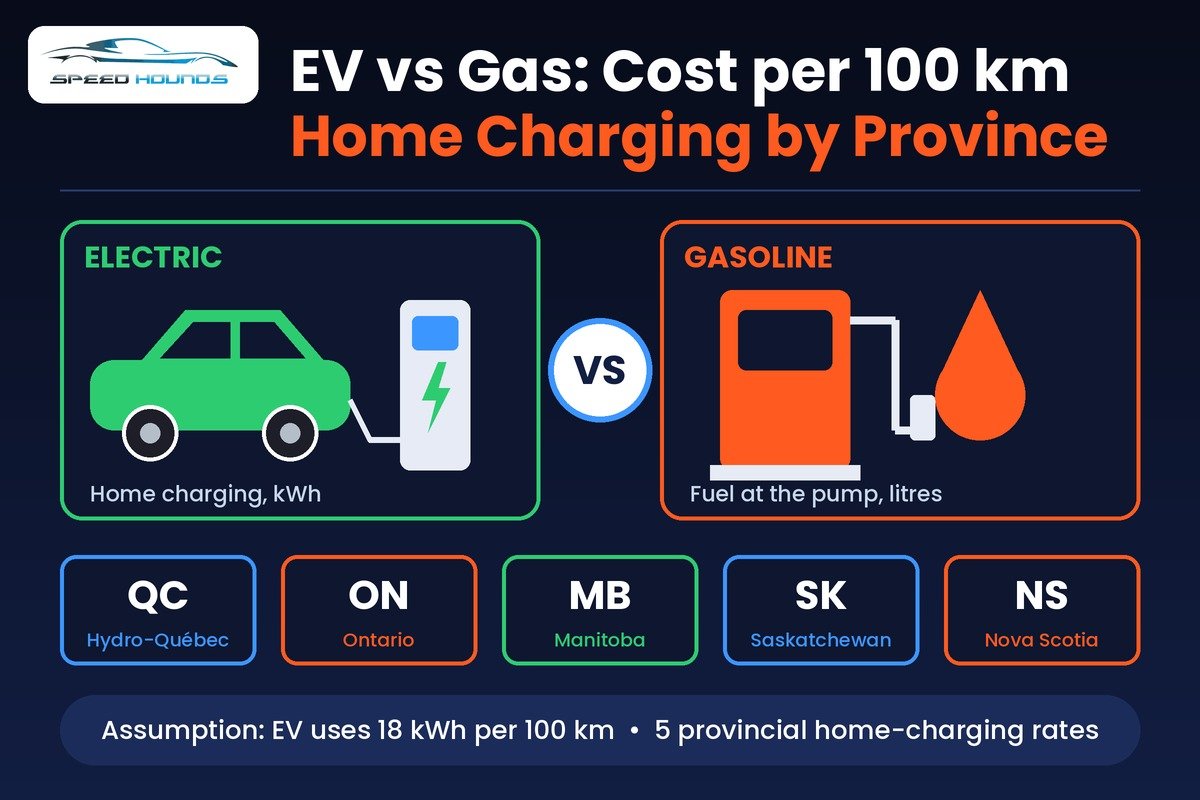
Charging an electric vehicle at home costs a fraction of what gasoline does in every province we checked, but the size of the gap depends heavily on where you live and which rate plan you are on. Natural Resources Canada’s 2026 Fuel Consumption Guide compares annual fuel costs using a gasoline price of $1.50 per litre and electricity at $0.18 per kWh over 20,000 km. This guide uses the same distance and gasoline price, then swaps in the actual 2026 residential rates from provincial utilities and regulators.
Last updated November 2026
The assumptions behind the numbers
Two vehicles set the comparison. The gas vehicle uses 7.5 L/100 km, the NRCan combined rating listed for the gasoline Hyundai Kona. The EV uses 18 kWh/100 km measured at the wall, an illustrative figure that includes charging losses and sits slightly above NRCan’s 1.8 Le/100 km rating for the Kona Electric. Your own vehicle will differ, so scale the results by your EnerGuide rating. Our guide to reading the EnerGuide label explains how.
The electricity prices below are energy charges only. Taxes, monthly basic charges and delivery fees that sit outside the per-kWh rate are not included, and a fixed monthly charge does not change just because you own an EV.
What 100 km costs on home electricity
The table multiplies 18 kWh by each published rate. Where a utility has more than one price, each is shown.
| Province and plan | Rate (per kWh) | Cost per 100 km | Cost per 20,000 km |
|---|---|---|---|
| Ontario, ultra-low overnight (11 p.m. to 7 a.m.) | 3.7¢ | $0.67 | $133 |
| Quebec, Rate D first tier (about 40 kWh a day) | 7.065¢ | $1.27 | $254 |
| Ontario, time-of-use off-peak | 9.1¢ | $1.64 | $328 |
| Manitoba, standard residential | 9.970¢ | $1.79 | $359 |
| Quebec, Rate D second tier | 11.142¢ | $2.01 | $401 |
| Ontario, tiered (first tier) | 11.2¢ | $2.02 | $403 |
| Ontario, tiered (second tier) | 13.2¢ | $2.38 | $475 |
| Saskatchewan, standard residential | 15.476¢ | $2.79 | $557 |
| Ontario, time-of-use on-peak | 18.9¢ | $3.40 | $680 |
| Nova Scotia, standard residential | 19.128¢ | $3.44 | $689 |
Sources: Hydro-Québec Rate D effective April 1, 2026; Ontario Energy Board prices for November 1, 2026; Manitoba Hydro, effective January 1, 2026; SaskPower, effective February 1, 2026; Nova Scotia Power, updated May 1, 2026. We did not include British Columbia or Alberta because we could not confirm their current residential rates from the utilities’ own pages.
What 100 km costs on gasoline
Pump prices move weekly and vary by province, so a single number would age quickly. This table shows the 7.5 L/100 km vehicle at four gasoline prices, with NRCan’s $1.50 per litre planning figure in the second row.
| Gasoline price per litre | Cost per 100 km | Cost per 20,000 km |
|---|---|---|
| $1.40 | $10.50 | $2,100 |
| $1.50 | $11.25 | $2,250 |
| $1.60 | $12.00 | $2,400 |
| $1.80 | $13.50 | $2,700 |
At NRCan’s gasoline price, the gas vehicle costs $2,250 a year to fuel. The same distance on the most expensive home rate in our table, Nova Scotia’s 19.128¢ per kWh, costs about $689 for the EV, or roughly $1,560 less. On Quebec’s first-tier rate the EV costs about $254, a gap of close to $2,000. Look up your own pump price in NRCan’s weekly retail fuel price tables and slot it into the second table.
Why the rate plan matters as much as the province
Ontario shows the spread inside a single province. A driver on the ultra-low overnight plan who charges between 11 p.m. and 7 a.m. pays 3.7¢ per kWh, while the same driver plugging in during the on-peak window pays 18.9¢. In winter the on-peak hours are 7 a.m. to 11 a.m. and 5 p.m. to 7 p.m. on weekdays, which is when many people get home and plug in. The overnight plan also carries a 37.7¢ on-peak price, so it rewards drivers who can reliably charge overnight and avoid the evening window.
Quebec works differently. Hydro-Québec’s Rate D charges 7.065¢ per kWh for energy up to about 40 kWh per day, and 11.142¢ above that. Electric heating can use up much of the first tier on a cold day, so winter charging may land partly in the second tier. Even at the higher rate, the EV in our table costs about $2.01 per 100 km against $11.25 for gas.
Manitoba and Saskatchewan charge a flat energy rate, so timing makes no difference. Nova Scotia’s 19.128¢ per kWh is also flat, which makes it the highest in our table, though the EV still comes out well ahead of gasoline.
What this comparison leaves out
Home charging is the cheapest way to run an EV, and public DC fast charging usually costs more per kilowatt-hour. If you rely on fast chargers, your cost per 100 km will be higher than the table shows. Our public EV charging guide covers networks and pricing.
Cold weather raises consumption for both types of vehicle. NRCan’s ratings are based on standardized testing, so real-world results shift with temperature, speed and load. A heavier EV pickup will use more than 18 kWh/100 km, and a hybrid will cost less to fuel than the gas vehicle used here.
Some provinces are also adding charges to EV ownership. Quebec plans a yearly fee for EVs from January 1, 2027, as we report in our Quebec EV registration fee story, and that cost belongs in a full ownership comparison alongside electricity.
How to work out your own number
Find your vehicle’s EnerGuide rating in kWh/100 km, or convert from Le/100 km, then find the per-kWh rate on your latest bill. Multiply the two to get your cost per 100 km. For gas, multiply your litres per 100 km by the pump price. Add your yearly distance, and the difference between the two results is your annual fuel saving.
A saving of $1,500 to $2,000 a year on fuel is a meaningful figure, but it does not decide the purchase alone. Compare it with the price difference between the EV and a similar gas model, the federal and provincial incentives that apply in your province, and your ability to charge at home. A buyer without a driveway or garage outlet will not see the home-charging figures above.