Importing a U.S. Vehicle to Canada: RIV Rules, Steps and Costs
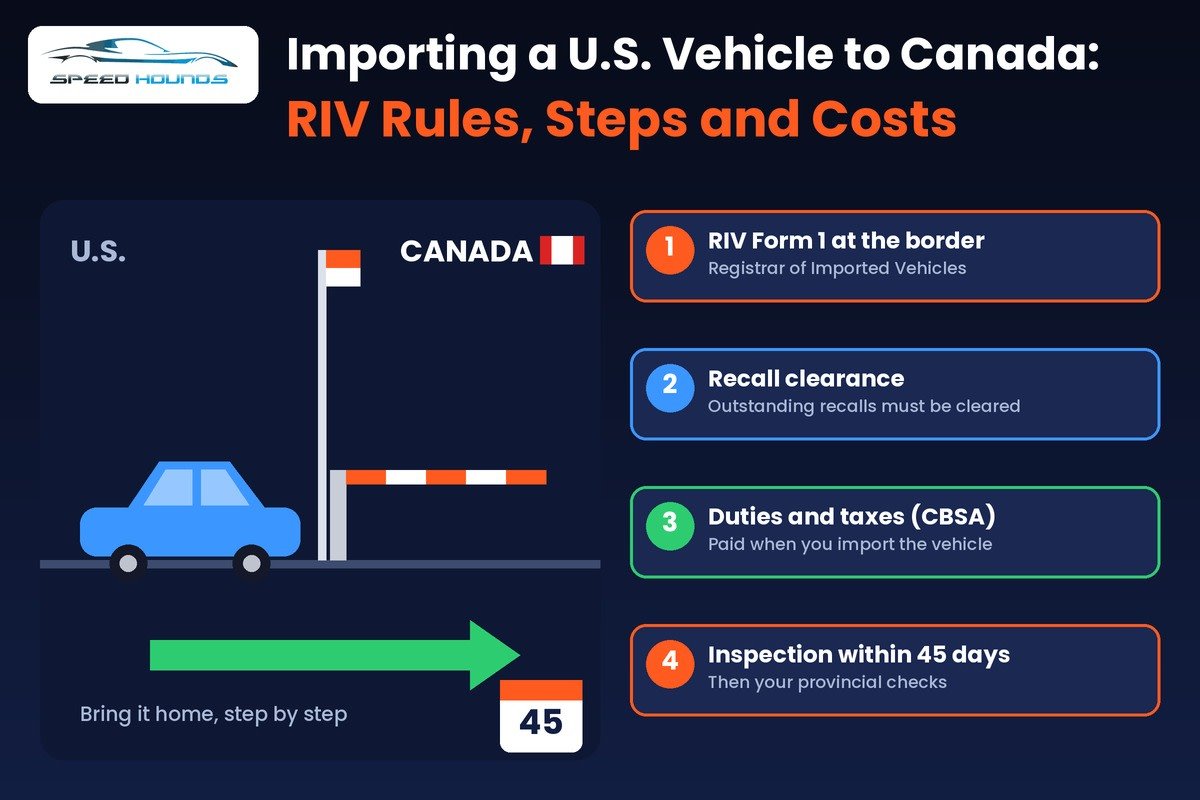
Buying a car south of the border can look like a bargain, but it only works if the vehicle can legally be registered in Canada. Transport Canada sets out the process, and the Registrar of Imported Vehicles (RIV) handles the paperwork and the inspection. Skip a step and a vehicle you have already paid for can be refused at the border or ordered out of the country.
Last updated November 2026
Check that the vehicle is allowed in
The first step is the RIV Compatibility List. It tells you whether a specific model and model year can be brought into Canada and what modifications the RIV expects. Transport Canada warns that the list is not guaranteed to be accurate and that a listed vehicle can still fail to meet Canadian requirements, so treat it as a screening tool, not a promise.
Modified vehicles are a common trap. Transport Canada says a vehicle that has been changed from its original state, such as a van converted to a motorhome or a truck with a lift kit, will not qualify. That applies even to Canadian-owned vehicles that were modified in the United States.
Age matters too. The Canada Border Services Agency (CBSA) treats vehicles 15 years or older from the date of importation as age-exempt from the federal safety regulations, and the importer has to give border officers adequate proof of the vehicle’s age. Newer vehicles go through RIV registration, and for that route the vehicle must be less than 15 years old on the date of importation. Buses are excluded from the age exemption.
The import process, step by step
Transport Canada lists the sequence for a vehicle coming from the United States or Mexico. The order below follows that page and the CBSA’s guidance on importing vehicles.
| Step | What you do | Why it matters |
|---|---|---|
| 1 | Look up the vehicle on the RIV Compatibility List | Confirms it is admissible and flags required changes |
| 2 | Clear the vehicle for export with U.S. or Mexican customs, where required | Avoids a hold on the U.S. side |
| 3 | Confirm there are no open recalls | Vehicles must be clear of recalls before they can be imported |
| 4 | Complete the Vehicle Import E-form (Form 1) on the RIV website and print all four pages | It cannot be submitted online; you present the printed copy at the border |
| 5 | Present the form and title documents to the CBSA and pay any duties and taxes | Clears the vehicle into Canada |
| 6 | Pass the RIV inspection | The vehicle is not officially imported until it passes |
The inspection has a deadline: 45 days, or one year for a salvage vehicle. Transport Canada is blunt about the downside. A vehicle that cannot be modified to comply must not remain in Canada and has to be exported, even though duties and taxes were already paid at the border.
Recalls and paperwork
An open recall can stop an import. The CBSA requires satisfactory proof that any manufacturer safety recall has been remedied. Before you commit, run the VIN through the manufacturer’s recall lookup and through Transport Canada’s database; our guide on how to check a vehicle recall in Canada walks through both. Keep in mind that a recall posted in Canada and one posted in the United States are not always the same list.
The CBSA also requires the original, valid U.S. state-issued Certificate of Title or an equivalent document. For vehicles going through the RIV, title documents are mandatory and must be submitted electronically, otherwise the CBSA will refuse entry. Sorting out a lien or a missing title on the seller’s side before you cross is far easier than doing it after.
What it costs to import a car to Canada
Budget for more than the purchase price. The RIV charges a fee for Form 1 that covers its compliance checks and the notices it sends to licensing authorities across the country. The last published increase, effective August 1, 2020, raised that fee from $310 to $325, plus GST or HST (GST and QST for Quebec crossings). The RIV can change the amount, so confirm the current figure on riv.ca before you plan around it.
At the border, you owe GST on the vehicle. The CBSA notes that in Nova Scotia, New Brunswick, Newfoundland and Labrador, Ontario and British Columbia the provincial part of the HST is collected when you license the vehicle, and other provinces may apply sales tax at registration. Vehicles with air conditioning carry a $100 federal excise tax, according to the CBSA memorandum on importing vehicles. The CBSA also assesses duty on vehicles manufactured in countries other than the United States and Mexico, so check the CBSA’s current tariff notices before you buy anything built outside North America or affected by a surtax.
Convert the sticker price carefully. Exchange rates, shipping and the cost of any modifications the RIV requires all land on top of the vehicle price. Our breakdown of what you actually pay for a new car in Canada shows how much freight, PDI and taxes add to a Canadian purchase, which is a useful yardstick when you compare an import against a local dealer’s out-the-door price.
After the border: registration and provincial inspections
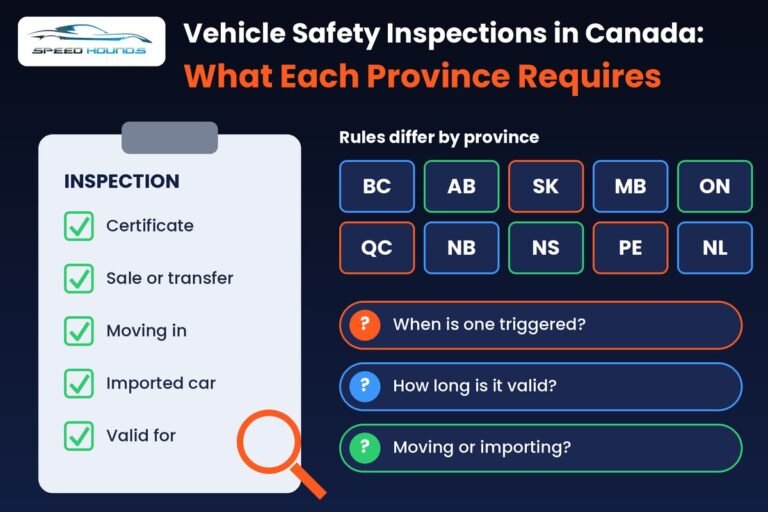
Clearing the RIV is not the end. Each province then decides what it needs before it issues plates. Ontario requires a Safety Standards Certificate when you register a vehicle bought in or brought from another country, and the certificate is valid for 36 calendar days from the inspection date. Quebec’s SAAQ lists used vehicles from outside Quebec among those that must undergo an occasional mechanical inspection. Alberta says vehicles registered outside the province must pass an inspection before plates are issued, and the certificate must reach a registry agent within 14 days of issue.
Plan the two inspections together. The RIV inspection is a federal safety check and the provincial inspection is a separate requirement, so passing one does not excuse you from the other. Our guide on buying a car in Canada: taxes, fees and protection by province covers the provincial registration costs that follow.
When importing makes sense
Importing tends to work best for a late-model, unmodified vehicle with a clean title, a known recall history and a model that appears on the RIV Compatibility List without a long list of required changes. It tends to go wrong with grey-market or heavily customized vehicles, and with cars that have open recalls the U.S. seller will not fix. If the price gap against a Canadian dealer is small once you add the RIV fee, taxes, shipping and an inspection, the saving may not justify the risk of a failed inspection.
Contact the RIV (1-888-848-8240) or Transport Canada’s Motor Vehicle Safety office (1-800-333-0371) before you pay for a vehicle. A short call about a specific VIN costs nothing and can save you from exporting a car you already own.